No-Comfort Zone Week ending Oct. 14

For this week, of course, the challenge continued to be ModPo. We began with Ruth Lechlitner and Genevieve Taggart, and then proceeded to Harlem Renaissance poets Countee Cullen and Claude

Portrait of Countee Cullen in Central Park. Ju...

McKay. And Gwendolyn Brooks.

Next we went in a slightly different, rather Anti-modernist direction with Robert Frost’s Mending Wall. We watched a YouTube discussion about that with Bob Perelman, Rachel Blau Du Plessis, John Timpane and Taije Silverman, ably hosted by Professor Al Filreis.

I haven’t quite finished up Week 5 yet, as I still have two videos to watch. One is a discussion of Richard Wilbur‘s Cottage Street, 1953 and then X.J. Kennedy‘s ekphrastic poem on Duchamp’s painting by the same name, Nude Descending a Staircase.

Robert Frost, Dartmouth 1896.

Robert Frost, Dartmouth 1896. (Photo credit: Wikipedia)

This is the stone wall at Frost's farm in Derr...

This is the stone wall at Frost’s farm in Derry, New Hampshire, which he described in “Mending Wall.” (Photo credit: Wikipedia)

But I have done Wilbur’s The Death of a Toad, (1950).

Looking forward to the coming week as we begin to look at The Beats.

Also this week I am restarting the Complete Health Improvement Program, CHIP, originated by Dr. Hans Diehl. Need a refresher, and need to be more focused this time around.

Haven’t managed to keep up with The Southeast Review’s 30-day Regimen, but that will be waiting for me when I am done the ModPo course. Then it will be time to get back to my own writing!

NO-COMFORT ZONE WEEK ENDING SEPT. 16 2012

Carol A. Stephen

This week my challenge was to start a 10-week course through Coursera

on Modern and Contemporary American Poetry given through the University of Pennsylvania. (ModPoPenn). This is a free course offered via a MOOC platform, or Massive Open Online Course.

Why massive? Well, there are more than 20,000 registered students. Yes, that’s right. Twenty thousand.

I had read about this back sometime in the early summer, and it sounded like a good course that would fill in the many gaps I have in my knowledge of American Poetry. I’ve heard of various schools like the Language Poets, the Post-Moderns, the Experimental.

But I wasn’t clear on what those were, or who belonged to which group.A week in now, and it has been wonderful, amazing, somewhat overwhelming. The number of discussions and posts going on make it hard to know where to focus, but I think I have a better idea how things will go from now on. Certainly I can’t read or respond to every post. So I will have to choose among them.

Already I have learned yet another term, proto-modernists, as we study Emily Dickinson

Emily Dickinson

Emily Dickinson (Photo credit: Wikipedia)

and Walt Whitman. They are leading us into

Steel engraving of Walt Whitman. Published in ...

Steel engraving of Walt Whitman. Published in 1855 edition of Leaves of Grass (Photo credit: Wikipedia)

Modern Poetry. In spite of how well-known these poets are, I have to admit to not reading them before. So it is interesting to read two different poets, both of whom were moving away from what was then the popular approach to writing poetry.

Thanks to Professor Al Filreis and the TA’s who are looking after us and guiding us along through the maze of the MOOC and the labyrinths of these two amazing poets!

Out of Love with the Frog

I’m posting this poem in response to a challenge on dVersePoets about rebellion. Since the prompt is quite broad, this poem seems to work for it. Comes from my first chapbook.

OUT OF LOVE WITH THE FROG
after Claudia Coutu Radmore

American Bullfrog Rana catesbeiana Side 1800px

American Bullfrog Rana catesbeiana Side 1800px (Photo credit: Wikipedia)

I’m not sure the exact day
I fell out of love with the frog
Rana catesbeiana…
was it the toothless mandible,
the way his eyes retracted
through roof of mouth
the fenestrated skull with its rows
of tiny teeth on maxilla?

I became prey, my every motion
a spur to devour me,
first my thoughts, then my character,
leaving me thoughtless and merciless.

Each strike his eyes would close,
then lunge, mouth open,
mucous tongue upon me
jaws continuing forward
clenching, grasping me in tiny teeth.
As we sank into swamp,
the frog tried to break my defences,
hold me under until I asphyxiated.
Obstinate as always, I broke free.

Carol A. Stephen

Originally published in Above the Hum of Yellow Jackets, Bondi Press, 2011

Using Sound Elements in Poetry: A Little Bacon and Egg Music

English: Bacon and Eggs frying on an electric ...

(Photo credit: Wikipedia)

The Daily Post Challenge yesterday was to write about The Sound of Blogging, incorporating sound into one’s writing. That got me to thinking about how sound is often used as a poetic device. As I went through some of my poems to assemble a set for a poetry reading, I came across A Little Bacon and Egg Music. That’s a poem I wrote responding to a different prompt, one to incorporate natural disaster juxtaposed with unrelated elements. That was part of the Southeast Review’s 30-day writing regimen back in February.  But when I came to titling the piece, it was so full of sound that it suggested music to me.

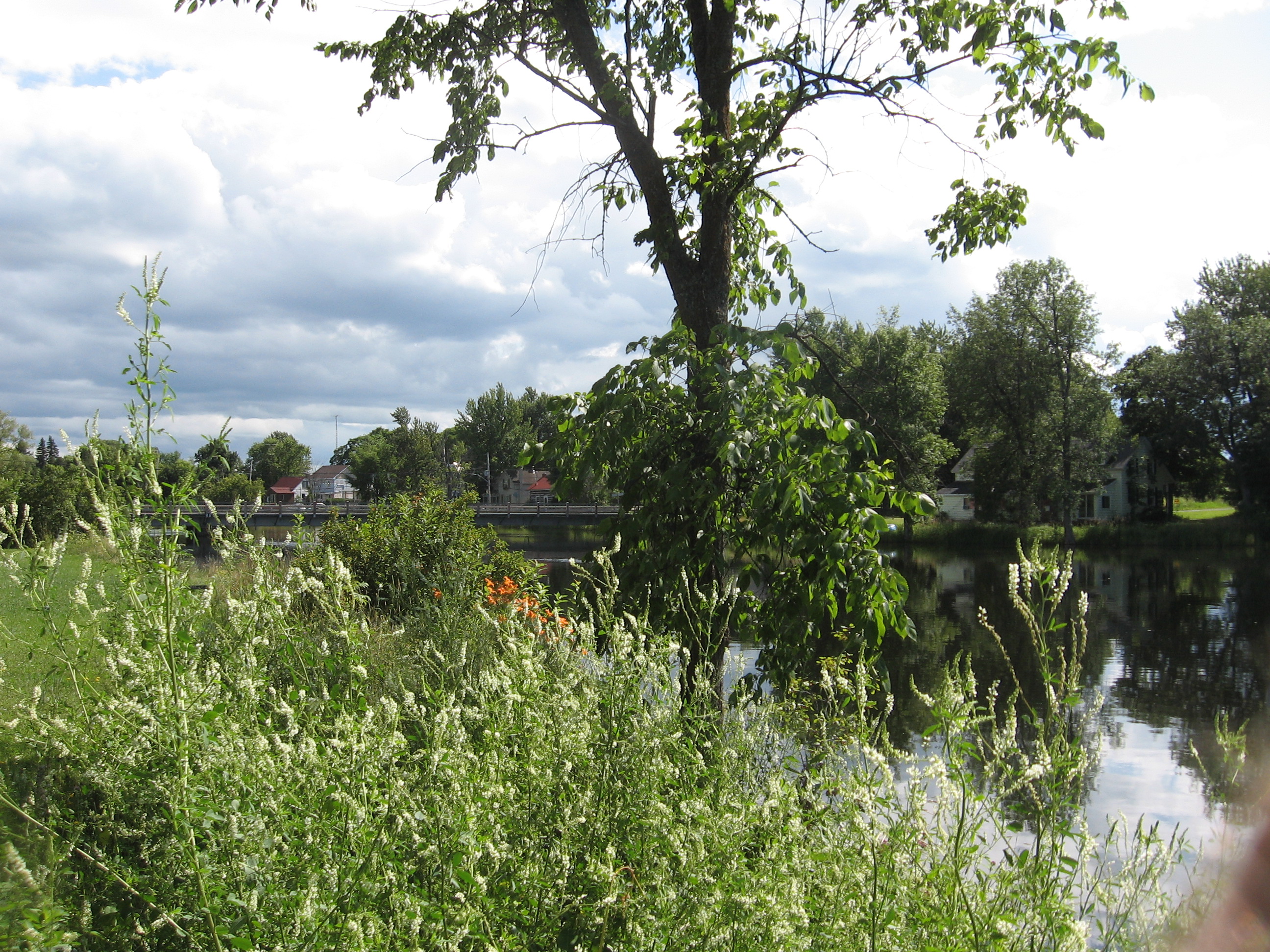
Here’s the poem (one clarification here. The Mississippi River referred to is not the one in the United States. It is the one that flows through my town, Carleton Place, Ontario.
For that river, it is quite possible for a tree bridge across one of its forks)  I tried to juxtapose the violent nature of a storm outside with an ordinary domestic scene at breakfast:

A Little Bacon and Egg Music

on the counter, the kettle whispers its morning boil in tune
toaster catapults crisp rye that leaps up brown and done.
spoons shiver in the sugar bowl, a subtle rustle of sound.

above the stove the wind torpedoes through the fan exhaust,
its assault thwarted so far by barriers of brick and
metal shaft elbowing round corners.

eggs bright as miniature suns gaze back at me
from where they sizzle in the pan. They cackle and spit,
a call for bacon’s smoky pizzazz, a little jazz lick.

out back, the crack and flash of lightning, as it knifes to earth,
the hoarse retort of a river oak split from leader to root into
a new bridge across the Mississippi fork.

Lightning 2

Lightning 2 (Photo credit: Wikipedia)

It seemed a good piece to use as an example of how sound might work in a poem. Sometimes, poets use onomatopoeia, trying to mimic in words the sound the words refer to.  Or, as Dictionary.com informs me:

on·o·mat·o·poe·ia   [on-uh-mat-uh-pee-uh, ‐mah-tuh‐]

noun 1. the formation of a word, as cuckoo, meow, honk,  or boom,  by imitation of a sound made by or associated with its referent.

2. a word so formed.

3. the use of imitative and naturally suggestive words for rhetorical, dramatic, or poetic effect

In the poem, I have tried to use onomatopoeia with the words sizzle, cackle, spit, to describe the sound eggs make as they fry. And again, in the use of crack to describe lightning.

Another way sound appears in poems is through sibilance.The “sssss” sounds in a poem. In the first stanza, the kettle whispers, spoons shiver in the sugar bowl, a subtle rustle of sound.

A poet might use assonance, repeating certain vowels: For example, in the second stanza, the “o” sounds of stove, torpedoes, and so. And in the third and fourth stanzas all the “a” sounds: back, crack, flash, and again the “o” sounds of hoarse, retort, oak, and fork.

Not to be outdone, the consonants too have sound effects, referred to as, of course, consonance.  The hard “k” sounds of kettle and catapult and crisp, the “p’s” of catapult and leaps. The “b’s” of barriers and brick, and later, bright and back. And my favourite two sounds that use both vowel and consonant: pizzazz and jazz.

As well as using sound for effect, word choice can convey the force of the image, so that the hard “k” sounds of words are more suggestive of the violence of the storm while the ordinary scene has more of the soft sounds that sibilance creates. (Except, of course, the catapulting toast!)