Day 24 Na PoWriMo Write a Lipogram

Day 24 NaPoWriMo says: “Today’s prompt is a bit of a doozy . . . so if you feel like you don’t have it in you, feel free, as always, to take a pass! Today’s challenge is a lipogram/Beautiful Outlaw/Beautiful In-Law. A lipogram is a poem that explicitly refrains from using certain letters. The most classic letter to swear off, at least for English speakers, is “e.” A Beautiful Outlaw is a variation on a lipogram, wherein you refrain from using any of the letters in a certain name. For example, if you chose the name Sarah, then you could not use s, a, r, or h. A Beautiful In-Law is another variant, wherein you only use the letters in a certain name (better pick a long name!)
You might think that any lipogram would end up having to be short, but some people have been successful at virtuoso performances in this vein — check out this excerpt from Christian Bök’s Eunoia, in which he uses no vowels except i. It goes on for nine pages!”

I guess the weather has got me down a bit, still cold although the sun,as it sets, is at its brightest so far today.  Still, the day made me think of storms and cold.

So for the prompt, I chose not to use the letter “i”.  Here’s my effort.

That Sort of a Day

A vacant acorn husk
spawns dream of tree, the oak
drops seed on ground to feed

Acorn hoarded by Acorn Woodpecker

Acorn hoarded by Acorn Woodpecker (Photo credit: Wikipedia)

woodpeckers and jays as they watch for the soak
of groundwater under trees that tease
yellows and reds to dance under

the faffer of breeze, scuddy weather
set free today the greys and blues of sky.

A storm comes on, then gone before
wet drops reach the lawn.
Today the best place to be

a warm bed or curled upon
the sofa where a fat furry cat
warms the soles of cold feet.

Carol A. Stephen
April 24, 2012
Day 23 NaPoWriMo Ekphrastic Prompt

Day 23 NaPoWriMo The prompt said:
” Today, I challenge you to write an ekphrastic poem — that is, a poem that responds to or is otherwise inspired by a work of art. Probably the most famous ekphrastic poem in English is Keats’ Ode on a Grecian Urn, but there is no lack of modern ekphrastic work. Take Auden’s Musee de Beaux Arts or Robert Lowell’s For the Union Dead. So go forth and find a painting, sculpture, photograph, or even a piece of music, and use it to inform your poem for today. Art creates art — it’s so efficient!”

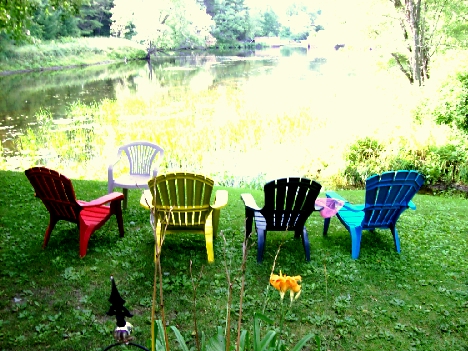
I used a favourite photo I took a couple of years ago at a writing retreat at Bridgewater, a place for artists and writers about two hours from home.

Where Have All the Poets Gone?

A Contemplation of Poets

On hot summer days even the sun
floats on the river for relief
hard bright light fading trees
to a blur that only remembers soft green.

Shade offers daylilies reprieve
from heat, yet their petals
curl and fade, prepare to fall.
Only the bright chairs

appear untouched by heat and fade
their colours brilliant even
in the shade. They wait. Poets
not seen but somewhere
near and always contemplating.

Carol A. Stephen
April 23, 2012

Day 22 NaPoWriMo Fruit or the Vegetable Lamb or…

The prompt for today said “I’d like you to write a poem about a plant. Flowers, of course, have been the subject of poems since time immemorial, and continue to be a source of much inspiration. But perhaps you could write about a tree, or a shrub, or grass. Maybe even a fictional or mythological plant. I could really see some good poems about the Vegetable Lamb of Tartary! (In fact, a few poems were written about it, back between 1550 and 1800. I say it’s time for a renaissance!)” 

The Vegetable Lamb of Tartary

The Vegetable Lamb of Tartary (Wikipedia)

Carol A. Stephen

So I read about that and it was interesting, another of those stories where everyone has a version and they are not necessarily the same, but not different either. So here’s my poem:
Of Mythical Tales of Watersheep and Barnacle Geese

Were watersheep born on the stem of a plant,
or Barnacle geese born of wood drifted slant,
or maybe both spawned from some strange fleshy fruit?
Perhaps they were mythical creatures to boot,
the stories embellished for use on fast day,
so men could still savour their meals on Friday.

Barnacle Geese. Facsimile of an Engraving on W...

Barnacle Geese. Facsimile of an Engraving on Wood, from the "Cosmographie Universelle" of Munster, folio, Basle, 1552. Project Gutenberg text 10940 (Photo credit: Wikipedia)

These men of the cloth and of pious belief
could eat meat those days in such a relief,
that these were the fruits of the water, the sea,
and so could be eaten most sensitively

on fish days and fast days and days in between,
they’d not have to worry the meat might be seen.
If meat is a fruit, it could be tomato,
or if it’s veggie, it could be potato,
and then there’s no sin that must be repented
no penance to do, and nothing resented.

It all sounds quite silly, I think you’ll agree,
just another old wives’ tale if you ask me.

Carol A. Stephen
April 22, 2012

Here, also, real Barnacle Geese, looking perfectly

normal.

Two Barnacle Goose (Branta leucopsis)

Two Barnacle Goose (Branta leucopsis) (Photo credit: Wikipedia)

No-Comfort Zone Week Ending April 23, 2012

Well, this was a busy but successful week. I attended two meetings on Monday, a lunch appointment on Tuesday and a much-anticipated and dreaded doctor’s appointment on Wednesday. But it appears I must have been doing something right on the health score, as my tests showed improved numbers. This is kidney-related, so has been an ongoing concern for several years now, and a complex one to deal with as far a diet goes.

What else? Well, on Friday I sent off my very first non-contest related submission to a national literary magazine. With some help from my friend Claudia. I promised her that it would be for this first one only, just to get me past the initial block. So that’s done. This week I am prepping for the Massachusetts workshop. Good news there too, as my brother will be back in town to cat-sit and house-sit etc. Have to admit though that the maps look rather confusing. Thank goodness for GPS.

I managed yesterday to catch up on both poetry challenges. But today I must clean up my desk so I can start the next batch of paper piles. My goal for the week to come is to work on Massachusetts-related “homework” and to pull together all the info I want to have on hand about the trip, the inn, and the workshop. And my travel lists. Only three weeks away now!

We’ll be staying here: http://brookfarm.com/ which is where most of the workshop will be held, but we will also take in some local sites. See below. The Mount was Edith Wharton’s residence, Steepletop was Edna St. Vincent Millay‘s. And I must mention our leader/instructor, James Arthur. James is a American-Canadian poet, writer, teacher, who grew up in Toronto but who now lives in the U.S. He was the instructor for the Stanford online 10-week poetry course that I took back in the fall of 2010. Two of the other students from that class will also be attending, so we will finally all get a chance to meet in person!

Pics of two places we’ll be visiting while in Lenox: Edith Wharton‘s Estate The Mount, Lenox  (our last day workshop will be held here)

The Mount, 2006

The Mount, 2006 (Photo credit: Wikipedia)

Alternative view of the front side of The Moun...

Alternative view of the front of The Mount, former home of Edith Wharton, in Lenox, Massachusetts. (Photo credit: Wikipedia)

Main house at Steepletop Farm, home of Edna St...

Main house at Steepletop Farm, home of Edna St. Vincent Millay (Photo credit: Wikipedia)