
NaPoWriMo 2016 Day 20 These Feet

NPM-Bookmark-front-376x1024glopo2016button2


Today’s prompt from FPR is quite a time-intensive one, and one that I will tackle later. This morning I have time constraints, so I decided to work with the Poetry Super Highway challenge to write a poem of place about my feet.

 Here is the prompt:

April 20, 2016: Poetry Writing Prompt – Ellen Sander

posted April 20th, 2016

Look at your feet. Are they bare, stockinged, shod? Recall some of the places your feet have been, e.g. the beach, grandparents’ home, the stairs of a school you went to. Write a “place” poem that starts with your feet.

This poetry writing prompt submitted by Ellen Sander.

My attempt:


THESE OLD FEET


These tootsies, cushioned and cozy,
wrapped round in sheepskin slippers,
real homebodies now but oh,
the places they’ve been!

The toes remember the tan sand beaches of Georgian Bay,
white sand of Cancun, the rough broken coral in Acapulco Bay
as the wash of tides roared in, tossed shells along the beach,
then slid back to join the deeper sea.

Acapulco, the town were the telenovela is set.

Acapulco. (Wikipedia)

They’ve suffered through the many rooms of Schönbrunn Palace
and Hampton Court, feared torture in London’s ancient Tower,
rested while we sipped a brew in a pub in Portsmouth,
sat out as inlaws danced at a rustic csárda in Budapest.

Hampton Court. View of the Great Gatehouse fro...

Hampton Court. (Wikipedia)

Soles have sweltered in unforgiving sandals wandering streets of
an August Rome, then thankful for the respite of street car ride,
Piazza Venezia to the Spanish Steps, and happy too to find running shoes
from Seoul to cushion bunions every step upon St. Peter’s marble floors.

The same old dogs walked twisted alleys along Venice’s canals,
tackled the top of Hong Kong’s Peak, curled to watch the milking of a Thai snake,
compressed themselves in ice-block boots to schuss down Mogul Alley,
and they still freeze at the touch of sole to kitchen floor back home.


Carol A. Stephen
April 20, 2016


Csárda is an old Hungarian term for tavern, from which Csárdás, the name for the traditional dance was derived.

NaPoWriMo 2016 FPR Impromptu 19 Flight

NPM-Bookmark-front-376x1024napo2016button1


Today, poet Michael Leong talks about various ways of translation and the use of found text to create something new, perhaps homophonic translation, taking a piece in another language and translating based on English words that  would sound similar to that word. (Or you might do a sight translation, choosing English words that look rather like the foreign ones.)

He has a few different ideas on how to approach new ways to translate which he discusses on the Found Poetry Review blog.

Michael doesn’t give any direct prompt or instruction, but suggests devising a translation method of your own, or using one already known.  For this prompt, then, I selected a poem from Czechoslovakian poet Miroslav Holub, The Fly, which I encountered in Ten Windows, by Jane Hirshfield. I could not find it in its original language, so I decided to go back to an earlier prompt and run the poem through a variety of translations on Google Translate.

This time I used French, Hungarian, Irish, Esperanto, Latin and back to English.  Once I had the translation done, I also translated the title. My favourite was the Esperanto, which gave me Dumfluge, which sounds very Germanic.  I was also left with a strange new word, carthilagineus, which I decided to leave in because I liked the sound of it!

Unfortunately during the translations the sex of the fly changed, the number fourteen somehow morphed into sixteen, and grammar was rather dumfluge too.  Only fierce cutting would give me something I could work with.  You can read the original poem here


drawing of a fly living on cherry plants

fly on cherry (Wikipedia)


This is my edited poem: 


Flight

Fleeing brown eyes and spread legs together
the immortal bluetongue

Fly was sitting on the horse. She eviscerated
the body, ate part of the eye quickly,
the arms and legs, the veins.

Silence of whisper and destruction
under the trees, she started
to lay eggs on the trunk of the willow

carthilagineus
and falling


A female fly (Sarcophaga sp.)

female fly (Sarcophaga sp.) \Wikipedia)

Carol A. Stephen
April 19, 2016


NaPoWriMo 2016 Day 18 Remember?

napo2016button2NMP-BANNER-D


Today’s NaPoWriMo prompt also triggered something although not strictly to the prompt to write in the language we remember from home.  I guess for me it has been too many years, and the differences are subtle ones. Much of Ontario was settled by Scots-Irish and English settlers. Much of the language doesn’t seem to have changed that much, other than the slang used.  And my grandmother passed away in the 1970’s, more than 40 years ago!  Mostly what I remember is just how much simpler everything was.

Not surprisingly, this poem has gone back to an earlier style of writing though, something closer to what I might have written back all those years ago.

Here are the prompt and my poem that it inspired:


NaPoWriMo Day 18

And now for our prompt (optional, as always)! Today, I’d like to challenge you to write a poem that incorporates “the sound of home.” Think back to your childhood, and the figures of speech and particular ways of talking that the people around you used, and which you may not hear anymore. My grandfather and mother, in particular, used several phrases I’ve rarely heard any others say, and I also absorbed certain ways of talking living in Charleston, South Carolina that I don’t hear on a daily basis in Washington, DC. Coax your ear and your voice backwards, and write a poem that speaks the language of home, and not the language of adulthood, office, or work. Happy writing!


REMEMBER?


I hear her voice yet now I can’t remember
as Granny’s words have faded over time.
Did she warn of snecking fingers in the window
or  remind  us be sure to latch the door?

Line art of a door screen.

a door screen. (Wikipedia)

She’d offer us fresh fruit on days mid-summer,
yellow with a blush of palest pink,
she’d call them peenches in her Scottish accent,
it was her word for peaches. At least, I think!

Mum was in the kitchen making sammiches.
She’d put ‘em in the icebox to keep cold.
Some days we’d get baloney, others, that funny spread,
or maybe she’d serve cream cheese with pineapple instead.


Embed from Getty Images

Was not so much the language I remember,
Granny’s lack of hearing twisted that.
More about the way that life was simpler.
We played outside and none of us were fat.

Hockey players lived just down the street.
We’d get their autographs when they drove by.
We knew the names of all six NHL teams,
In those days even girls saved hockey cards.


Carol A. Stephen
April 18, 2016


NaPoWriMo 2016 FPR Impromptu 18 Mother, My Mirror

NPM-Bookmark-front-376x1024napo2016button2

Today’s prompt comes from FPR, Impromptu poet Amaranth Borsuk, who suggests three different ways to approach today.  Here, I have given only the instructions for the one I chose, The Deletionist assist


A) The Dictionary Assist

C) ABRACADABRAssist

Abra: A Living Text is a magical poetry spellbook for iPad and iPhone. Ian Hatcher, Kate Durbin, and I made this free app to put the text of Abra (1913 Press, 2016), a poem that mutates on the page, in readers’ hands, troubling the boundary between author and reader.

To see the full post, including the instructions for all three prompts more info on the poet, and links to other poems for this challenge, go to http://www.foundpoetryreview.com/blog/impromptu-18-amaranth-borsuk/

MY CHOICE B) The Deletionist Assist

The Deletionist is a JavaScript bookmarklet that Nick Montfort, Jesper Juul and I made. It converts any webpage into an erasure using a series of constraints from which it selects the one that reveals the most interesting “Worl” within the World Wide Web.

  1. Go to http://thedeletionist.com/ and drag the icon on the page into your browser’s bookmarks bar.
  2. Go to several website you’d like to erase (gmail will let you get personal, Project Gutenberg will provide interesting source material, and nyt.com will provide contemporary flavor–open a number of sites in different browser windows).
  3. Click the “Deletionist” bookmark and watch the dutiful Deletionist remove most of the language on your page. Harvest any phrases that interest you (you won’t always get phrases, so if you don’t like the results, try another site).
  4. Use this material for poems or screencapture page results you like.

Not having ready access to the recommended dictionary and being a lazy poet,  nor having either an iPad nor an iPhone, I followed the 2nd prompt, using the Deletionist tool.  The first thing I tried gave me many lines that were perhaps promising but all beginning with O, and sounding much like a paean to odd attractions.  This one came from a Brain Pickings article by Maria Popova featuring Ursula K. Le Guin, on Aging and What Beauty Really Means https://www.brainpickings.org/2014/10/21/ursula-le-guin-dogs-cats-dancers-beauty/ 

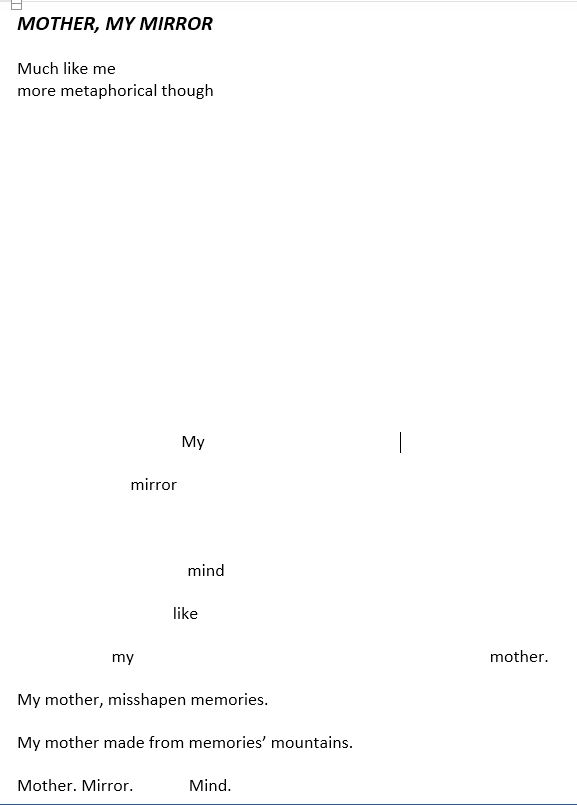
Here is what I ended up with, after some further erasing to carve out the poem. I did this in Word, removing text by simply changing the font from black to white, so I could retain the spacing, and effect of erasure. Then I used a snipping tool, et voilà !

MOTHER MY MIRROR


Lady looking into mirror, Belur Halebidu

Lady looking into mirror, Belur Halebidu (Wikipedia)