
NaPoWriMo 2016 Day 11 Cold Feet

NMP-BANNER-Dglopo2016button1


Today’s prompt comes again from napowrimo.net. A seemingly simple challenge, but it’s not, and made more difficult by being given James Wright’s poem as a sample.  Here’s the prompt description:


Day Eleven

On April 11, 2016

And now for today’s (optional) prompt! Today, I challenge you to write a poem in which you closely describe an object or place, and then end with a much more abstract line that doesn’t seemingly have anything to do with that object or place, but which, of course, really does. I think of the “surprise” ending to this James Wright Poem as a model for the effect I’m hoping you’ll achieve. An abstract, philosophical kind of statement closing out a poem that is otherwise intensely focused on physical, sensory details.

I did try FPR’s astrological prompt, but that just wasn’t working for me, although I found the colour oracle version and the colour horoscope quite intriguing.  The forecast predicted some things I really did not want to think about, Instead, I went with my rather mundane morning routine, reading a little poetry, keeping warm…


English: Blue-footed Booby (Sula nebouxii); sh...

Blue-footed Booby (Sula nebouxii) (Wikipedia)


Cold Feet


Outside the rain hammers hard
against the windowpane, but here
inside my warm cocoon I stretch
cozy, wrapped in a new blanket,
its soft plush brushes against my palm
silky as a cat’s coat. It doubles down
to cradle cold feet, drawing away all chill.
Under my head, a downy pillow, two soft
cushions, and a neck rest prop my head
as I read another brilliant Bly poem
in Stealing Sugar from the Castle.
Today I didn’t attend a funeral.


Carol A. Stephen
April 11, 2016

NaPoWriMo 2016 Day 10 : Cracking the Spine

NMP-BANNER-Dnapo2016button1


For today, I chose to do the prompt posted on napowrimo.net


Today’s prompt comes to us from Lillian Hallberg. She challenges us to write a “book spine” poem. This involves taking a look at your bookshelves, and writing down titles in order (or rearranging the titles) to create a poem. Some fun images of book spine poems can be found here. If you want to take things a step further, Lillian suggests gathering a list of titles from your shelves (every third or fifth book, perhaps, if you have a lot) and using the titles, as close to the originals as possible, to create a poem that is seeded throughout with your own lines, interjections, and thoughts. Happy writing!


I’d been working on a 10-word, 48-hour contest poem for the CV2 annual April event (sorry registration closed Apr. 4) and there was just not enough hours today to tackle an intricate prompt. This one was indeed, a change of pace.  I simply scooped up an armful of poetry books and used those as my source. For the poem I selected about two thirds of the titles, and inserted four words (in parentheses) to round it out. The names of the poets appear below, in the order I used their titles.


Cracking the Spine

spine and hip bones

wood engraving (Wikipedia) spine and hip bones

Sailing the Forest
On Glassy Wings,
The Eternal Ones of Dream,
Coping with Emotions and Otters  (play)
Hide & Seek.

Bye-and-Bye,
Stowaways (go)
Sprinting from the Graveyard.

Some bones and a story (make)
(A) Satisfying Clicking Sound.

Just Saying.

Carol A. Stephen
April 10, 2016

English: Skeleton animation


In order, titles from Ariel Gordon, Goran Simić, Robin Robertson, Anne Szumigalski, James Tate, Dina Del Bucchia, Susan Glickman, Charles Wright, Alice Major, Jason Guriel, Rae Armantrout

NaPoWriMo 2016 FPR Impromptu #9 What We Carry with Us

NMP-BANNER-Dnapo2016button1


Today’s IMPROMPTU prompt comes from Frank Montesonti:

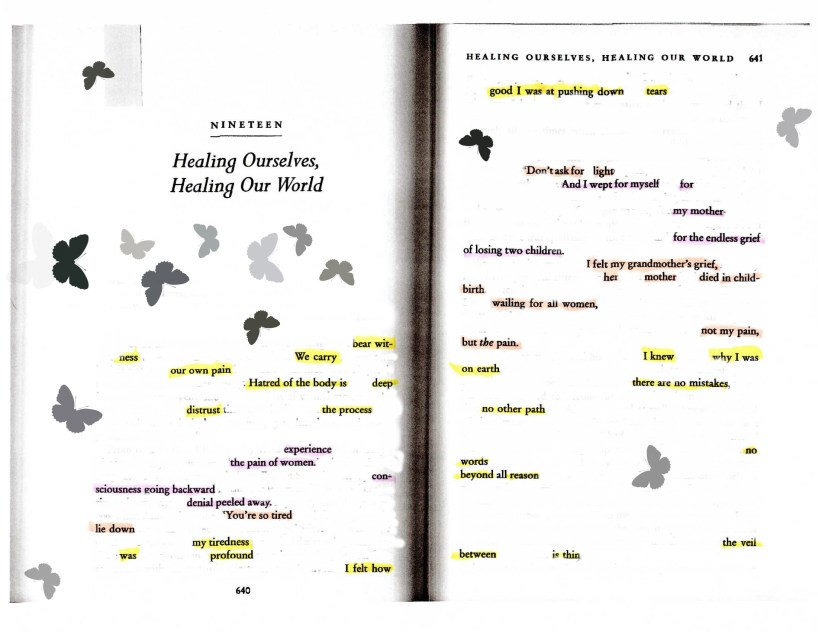
“Find an erasure text from a usual source – the book rack at Goodwill, a newspaper, an old manual. When you approach the erasure text, however, don’t think that you are trying to uncover just one voice. Think in terms of creating a dialogue. Highlight some phrases or words in one color, then feel if there might be a response to those words somewhere else in the text. How many voices do you hear in the text? Two, three? If so, highlight them each in their own color. What is the conversation that is happening between the colors and in the text?

There might also be places where you feel the two voices overlap. In this case, since you are using primary colors, if you highlight the same words in two different primary colors, they create a new color, a secondary color representing a choral aspect of the erasure.

A fun aspect of this activity is that it can collaborative. Two or more poets can work on the same erasure project by handing a book back and forth and creating a conversation.”

For more about Frank Montesonti, and to view the whole post: http://www.foundpoetryreview.com/blog/impromptu-9-frank-montesonti/


Here is the poem that emerged, each voice shown in its own  style:


What We Carry with Us


Bear witness.  We carry our own pain.
Hatred of the body is deep. Distrust
the process.

Experience the pain of women
consciousness going backward,
denial peeled away.

 you’re so tired. lie down.


 My tiredness profound,
I felt how good I was
at pushing down tears.

don’t ask for light.

 
And I wept for myself,
for my mother, for the endless grief
of losing two children.

 I felt my grandmother’s grief,
her mother died in childbirth
wailing for all women,
not my pain but the pain.


 I knew why I was on earth.
There are no mistakes, no other path,
no words beyond reason.
The veil between is thin.


Carol A. Stephen
April 9, 2016


My source text is the book, Women’s Bodies, Women’s Wisdom by Christiane Northrup, M.D. ©1994 from Bantam Books. pp. 640-641


Healingscan_0004

NaPoWriMo 2016 Impromptu # 7 Cento: Only About Light

NMP-BANNER-Dglopo2016button1


Today’s prompt at Found Poetry Review comes from Simone Muench, who wrote a favourite of mine, a collection titled Wolf Centos. Please click on the link to access the full post, and for more information about Simone, as well as to view other poems answering the challenge today.

The prompt:

“The Brazilian poet Manuel Bandeira created the cento “Anthology” (see below) using lines from his own poems, instead of employing the traditional method of cento-construction (in which you build a poem entirely out of lines from other people’s poems). Following his example, write a cento that is a self-portrait, or anthology of your life, utilizing lines and fragments from your own work.

Or, alternatively, create a “self-portrait” cento using lines and fragments from other people’s poems (the traditional method), or song lyrics, or prose (fiction and/or nonfiction)

*To see the basic stipulations for writing a traditional cento, see http://myenchiridion.blogspot.com/2008_08_01_archive.html 

I decided to use my own poems as source material.  To keep it simple, I chose only from poems written in 2016.  My attempt is titled “Only About Light”

Only About Light

Sometimes I wake, not because there was music—
here the silence deafens as only silence can.

Suppose the world was only about light—
the ultra-sentient particles.

I convince myself each fear is a chimera
while we sleep the Earth rotates east

the song dog
lifts his muzzle to the wind

and desert dog song soars skyward in a moon moan
but he doesn’t understand the depth of sky.


Carol A. Stephen
April 7, 2016


*the phrase, song dog is quoted from Alice Notley’s Culture of One


Embed from Getty Images


For more centos also check out Newfoundland poet, Mary Dalton, who wrote Hooking.  Each of the poems in this collection used lines from a specific location in the source poems, for example a poem might consist of lines that were the 9th line of each source poem.  Her process is detailed at the back of the book. Hooking, from Vehicule Press

At this link, Mary discusses her book in an interview with The Malahat Review’s John Barton.