
In Week 10, the final week of ModPo, we met Kenneth Goldsmith, Christian Bök, Erica Baum, Caroline Bergvall, Michael Magee, Rosemarie Waldrop, Jennifer Scappettone and Tracie Morris.

Kenneth Goldsmith (Photo credit: Wikipedia)
We started off with Goldsmith’s Soliloquy, a book transcribed from Goldsmith’s recordings of himself for a one-week period. This includes only his side of conversations, and nothing has been edited out. Goldsmith has also released a book that transcribes one entire day from the New York Times. It is 900 pages long. Goldsmith teaches a course about uncreative writing, where students are penalized for showing originality. Their work must be taken from other writers’ work, patchworked, cut-and-pasted, and thus repurposed. He has written that there is enough writing in the world already, that we should, in effect, re-use and recycle. But to make sure I am not misquoting, you can read for yourself here: http://chronicle.com/article/Uncreative-Writing/128908/
We then moved on to Canadian poet, Christian Bök‘s Eunoia, Chapter E. Eunoia is the shortest English word that contains all five main vowel graphemes, apparently. Bök‘s constraint was to write each chapter using one, and only one of the vowels in the chapter. This took him seven years to complete, and won the 2002 Griffin Prize for Poetry. A number of students made efforts to come up with poems, stanzas or phrases that used this constraint. In one student’s final essay, she did a remarkable job of using exactly this constraint. Bök also created languages for both Gene Roddenberry’s Earth: Final Conflict and Peter Benchley’s Amazon.
Erica Baum is a poet and photographer who has combined both in the visual poems we studied: Card Catalogues and Dog Ear. Interesting to note that some students tended to read the words or phrases from the card catalogue differently than the way they were put together by the teaching staff. I started from the front and worked backwards, while the video discussion started on the left hand side, which meant working from the back of the file to the front. While I don’t plan to become a visual poet myself, I can certainly see how this might work as a blogger about poetry.
We then moved on to Caroline Bergvall’s VIA. Her concept was to take the first stanza from Dante’s The Divine Comedy, and then she looked for all the different translations she could find in the library. (Here is an article about working with translations.) She then stacked them in alphabetical order by the first line. She reads it here in a even tone, each stanza, then the translator’s name, then the year of publication. It is interesting to note the slight nuances of meaning as the translators interpret the original Italian.
After that, we looked at Michael Magee’s Pledge, stanza after stanza of riffs on the American Pledge of Allegiance. At first, I didn’t realize just from the title what it was, but finally clued in on how it might sound read aloud. This was a series of homophonic translations of the Pledge. I found myself checking for the original words, as there were some differences from the Canadian pledge I remember from school, and which, apparently, no longer exists. At least, no pledge to the flag exists.
Then we studied Magee’s My Angie Dickinson. This takes Emily Dickinson poems, using Emily’s dashes and style. It is a disruptive parody that weaves in flarf (Google search results) from various TV and movie roles that actress Angie Dickson played, and also honours Susan Howe’s My Emily Dickinson.

Cover of My Emily Dickinson
Rosemarie Waldrop’s concept for Shorter American Memory of the Declaration of Independence used the technique of collage, drawing from Henry Beston’s American Memory from the 1930’s which she then applied the N+7 constraint of taking every noun, and replacing it with the one that falls seven nouns after it in the dictionary.
Jennifer Scappettone‘s Vase Poppies is a hark-back to H.D.’s Sea Poppies imagist poem, using the sound, rhyme, number of words per line and number of lines per stanza from H.D.‘s poem. Scappettone used rhyme as she called it, “schmaltzification”. During the video discussion the comparison was made that Cage’s Writing Through Howl poem was to Ginsberg’s Howl what Scappettone’s Vase Poppies is to H.D.’s poem.
The final poet on the final week was Tracie Morris, whose poem, Afrika (video of it is the third poem on the Pennsound page), is a spoken word/music poem which is very much influenced by the nuances of the individual sounds, repetitions and disruptive flow of words stopping, starting, restarting. There is also a version that is a collaboration, adding music to the composition.
The poem never really seems to get going, stuck as it is in its repetitions. It is a poem about slavery, the arrival in America, the history of America. And even in its disruption, still provides a coherent narrative if you consider the back story and how the inflections, tone, the words relate to that history.
The final video discussion for Week 10 examined the Morris poem, and then moved on to talk about how the course of study has brought us through the lineage of modern poetry to Morris, the reflection of Stein and Dickinson here, of Cage. Final words came from each of the TAs. Here are my impressions of what I took away from their comments:
Max: “Will we, over this century, come back to the “what”.
Molly: worries about experimentation for the sake of experimentation.
Kristin: sees the lineage of modern poetry, sees Stein, sees Dickinson in “it” and “this”.
Al: hears Cage breaking the language down.
Anna: is reminded that language is a living breathing organism. Making it new = remaking it new= making it newer.
Ali: finds it easy to marvel at Tracie’s voice, her presentation. Gets pleasure from engaging with it.
Dave: likes how the poem lets you know the delivery of the poem IS the poem. You miss most of the message if you concentrate on content.
Amaris: history embedded in each word. Language is a living thing, renewed consciousness.
Trend in poetry moving from the authority voice to learning voice.
AL: Model a collective, collaborative close reading. The crowd is wise. The crowd has more to say than one expert.
Goal metapedagogically: to model a kind of collective reading of the poems that gets better the more we say on it.
Emily: renewed consciousness. Likes Afrika and Via of this section, which are also some of her favourites from the whole course. Experimentation augments the content, confrontational but not dogmatic, polemic or proselytizing. Asking a deeply important question, how we share our life experience, formal way of asking a question.
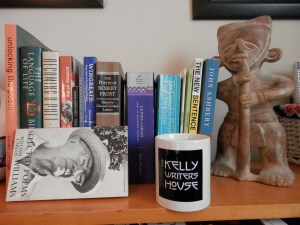
The following Monday there was a live webcast of goodbyes from the teaching staff, from the ModPolians who travelled to Philadelphia for the dinner the night before and went to the Kelly Writers House to attend the final webcast, and from those who called in from around the globe. And those of us who shouted our farewells from the sidebar chat on YouTube as well as from the discussion forums.
Is it over? No. The site is available for a year for us to review and to catch the discussions and further readings that we didn’t manage to squeeze in, or to revisit the ones we did. There are new discussion forums set up for us to discuss new material, and a couple of FB groups. There is a new blog for alumni to join, which we hope will continue after the official site has been closed down. There is a committee working to put together an anthology of poems from the ModPolian students who are also poets, and perhaps essays from those who are not poets. One student has set up his own blog to include a blogroll of ModPolians. Did I say we had a good course? Must be so, because no-one wants to see it end!
P.S. I should have commented further about the final webcast. This is the only course I have ever taken where not only were the students teary-eyed over saying goodbye, but so were the teaching staff, including the professor, Al Filreis! That really says it all, doesn’t it?
 Who am I? I ask myself this all the time. I am a poet. Retired bean counter. Cat lover.


 Quillfyre