Small Stone for Jan. 16, 2014

badge-14-300x300Today’s poem by Rilke is Not By Grasping, which you can read here: http://yearwithrilke.blogspot.ca/2011/01/not-by-grasping.html

In the poem Rilke says “To sing is to be. Easy for a god. But when do we simply be?”  
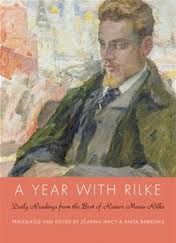
AYEARWRILKE

I’ve shared the link to the poem because there is so much to think about in a scant 14 line sonnet.  Unlike some of the passages so far, I had to think a long time before making my choice which lines to respond to. I’ve quoted the closing couplet as an epigram to my short poem here.

Jan. 16, 2014

Truly to sing takes another kind of breath.
A breath in the void. A shudder in God. A wind.  – Rilke

Some days the poems flow, words
tumble one over the next, as if they
come from somewhere beyond thought.

But as  I try to write the dark shadowed words—

Shadows in the late afternoon.

Shadows in the late afternoon. (Photo credit: Wikipedia)

as thought turns inwards—

I become blind and mute. Today,
I stumble and tremble to sing my song.

–CAS

The Only Journey

The Only Journey (Photo credit: Celestine Chua)

Enhanced by Zemanta

Small Stone for Jan. 15, 2014

Letters to a young poet

Letters to a young poet (credit: Xpectro)

badge-14-300x300For January 15, A Year with Rilke again shares a passage from Letters to a Young Poet, Paris, Feb. 17, 1903.

Rilke advises the young poet that as he “unfolds as an artist”to keep “growing through all that happens to you.”  He then tells him that looking outside oneself for answers is a violent disruption to the process, and that answers lie within ourselves.

Through the Chaos

Jan. 15, 2014

How do I hear myself
amid the buzz of babble,
the blab of the pave inside?

Outside, there is ebb and flow

Couleur Café
to the cacophony of sound,
noise of the crowd fades in and out.

*

But here, even when sleeping
I cannot still the tangle of incessant voices
that hides what I feel and truths I might believe.

Tangled Roots

Tangled Roots (Photo credit: acaben)

–CAS

Enhanced by Zemanta

Small Stone for Jan. 14, 2014

badge-14-300x300Today’s passage from A Year with Rilke is dated Aug. 12, 1904, and comes from Letters to a Young Poet.

Here, he tells us that fate is not an external force, but something that comes from ourselves. He says just as we were wrong about the sun’s movement, we are also wrong about what is ahead.

Jan. 14, 2014

If fate lies
inside us,
what changes might we
still have power to make?

If we think differently now,
live differently, can we
slow or halt disease
our careless lives have brought?

Letters to a Young Poet, by Rainer Maria Rilke

Letters to a Young Poet, by Rainer Maria Rilke (Photo credit: elycefeliz)


–CAS

Enhanced by Zemanta

Small Stone for Jan. 13, 2014

badge-14-300x300The poem for Jan. 13 in A Year with Rilke is titled, “Be Ahead of All Parting”. Rilke here encourages treating a parting as if it had already taken place, and to return from this to connection.

Rainer Maria Rilke

When I decided to buy this book, I really was quite unfamiliar with Rilke’s work, and had no inkling of how closely it would correspond to the thoughts and fears that I’ve been trying to deal with for the last couple of winters. I am hoping, through writing down my responses to the daily readings, to work through my own confusion and fear to find a quiet place inside where I can enjoy life fully.  I have included a quote from the poem, the 3rd of 4 stanzas, as that is the essence, I think, of my own struggle.

Jan. 13, 2014

..Be. And know as well the need to NOT be:
let that ground of all that changes
bring you to completion now.  —Rainer Maria Rilke

Here is the difficult thing.
To know that death is coming,
to balance knowing with
living fully in the present.

An hourglass

An hourglass (Photo credit: Wikipedia)

To connect with now,
to leave the past behind.
To know that life is lived
only in the present, to enjoy
each moment that we are.

–CAS

Enhanced by Zemanta