

NaPoWriMo 2016 FPR Impromptu 27 The Nature of Hills & Niagara

NPM-Bookmark-front-376x1024napo2016button1


Today’s prompt on the Found Poetry Review blog offers a choice of constraints from Montrealer Greg Santos.  Here’s what he’s suggested, every one of them are worth trying:

  1. Dialogue with Ghost:  Find an audio recording of a dead poet or musician. Play the recording. Start writing words that jump in your head, lines of your own. Write a 10-14 line poem using the words you jotted down, either in response to the original poem/song or a completely new piece.
  1. Reverse Poem:  Find a draft of a poem you’ve already written. Rewrite your new poem backwards, writing the last stanza first and so on. The new order might reveal something new and exciting.
  1. Table of Contents Poem: Use the table of contents of any book to find each line for your found poem.
  1. Online Erasure Poem: Go to Wave Books’ Erasures website to find online source texts, with excerpts ranging from Herman Melville’s Moby Dick to The Voyage Out by Virginia Wolf. The cool website lets you click on any word or punctuation mark to make it disappear. You can save, print, or email the newly sculpted text when you’re done.

Today I tried first the Reverse poem.  Two shorter poems did not seem to change much nor for the better, but a longer poem was a little more interesting. I chose a found poem I had done last summer from a prose piece of Walt Whitman’s, On Seeing Niagara to Advantage. That poem is here, followed by the reverse version, with some further carving done to it.

The blog post and other poems for this challenge are found here: at Found Poetry Review

On Seeing Niagara to Advantage
found in Walt Whitman 

English: Walt Whitman. Library of Congress des...

Walt Whitman. (Wikipedia)

     June 4, ’80.

Seizing the common sunshine,
the mystery of identity, there comes
some lucky five minutes of  fortuitous concurrence,
circumstance bringing a brief flash of thought about two o’clock.

This afternoon gave me Niagara, superb severity of action, color,
majestic indescribable show. Slowly crossing the Suspension bridge,
not a full stop anywhere, and I out on the platform, the falls in plain view,
a mile distinct, and no roar, a murmur-river tumbling green and white,
the plentiful umbrage, many bronze cedars, shadow tempering
immense materiality. Clear sky, a few white clouds silent.

Brief quiet, a remembrance always afterwards.
I lay away rare and blessed bits of hours,
—the wild sea-storm one winter,
—night-views on the field, after battles
—the peculiar sentiment of moonlight
—stars over Kansas
—a stiff breeze off Navesink.

That afternoon five minutes’ perfect absorption.
Niagara— the great majestic gem complete
in indispensable surround.

Carol A. Stephen

http://genius.com/Walt-whitman-seeing-niagara-to-advantage-annotated
excerpt from Whitman, Walt, Specimen Days, 1882

And this is the poem I carved out today from the one above:

On Revisiting Niagara April 27, 2016

I lay away rare and blessed bits of hours
brief quiet, a remembrance.

Always afterwards, immense materiality,
clear sky, a few white clouds silent.

The plentiful umbrage, many bronze cedars,
shadow tempering a mile.

No roar, a murmur-river tumbling green and white,
not a full stop anywhere.

Crossing the bridge gave me Niagara,
A brief flash of thought about two o’clock.

Five minutes of identity
seizing the common sunshine.

Carol A. Stephen

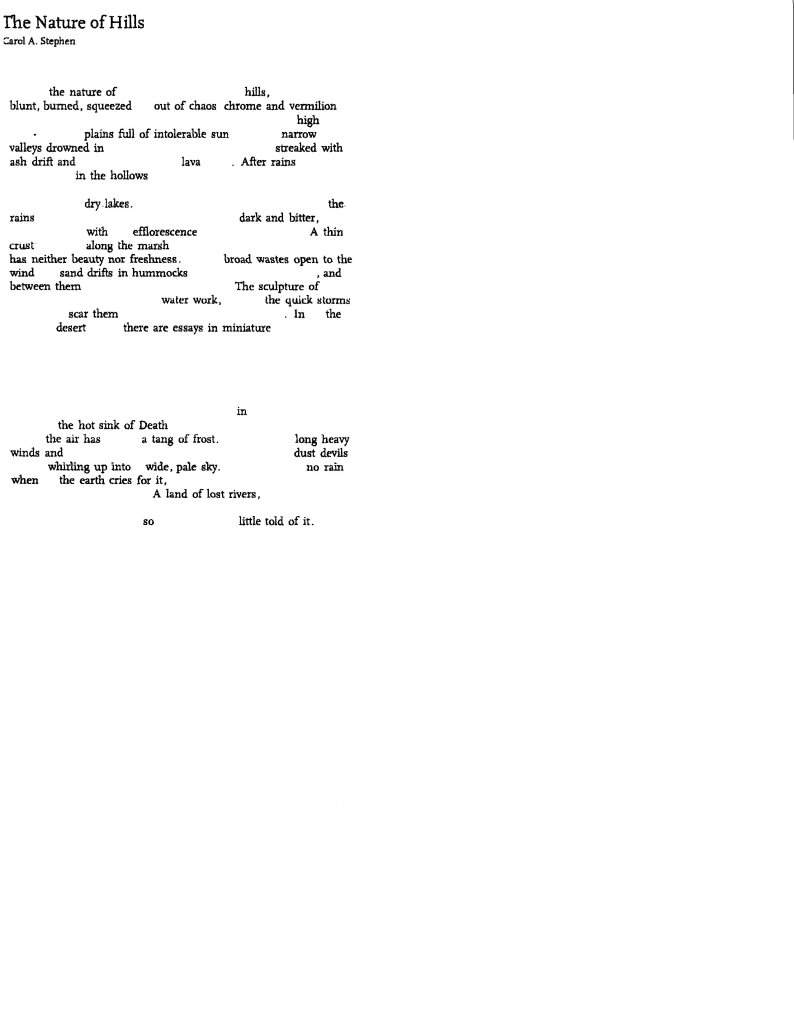
But I wasn’t convinced it was “my” poem for today.  The Ghosts prompt is tempting but no idea where to start so I went with the Erasure generator from Wave Books. I was disappointed that I could only print it in tiny print, and the site would not, for some reason, allow me to sign up so I could email or save.  But I did manage to get an image of it.  I found it a challenge as both times I tried the erasures I ended up putting back words that I thought I had erased, and erasing words I wanted to keep, so the image text is a bit different from my transcribed version, which is the “final” one.  The text was taken from The Land of Little Rain by Mary Austin.http://erasures.wavepoetry.com/sources.php


The nature of                                         hills,

High desert

High desert (Photo credit: Wikipedia)

blunt, burned, squeezed                out of chaos       chrome and vermilion

                                            high

                plains full of intolerable sun               narrow

valleys drowned in    blue                                              streaked with

ash drift and                                 lava.          After rains

in the hollows,

dry lakes.                                                           the

rains                                                               dark and bitter,

with efflorescence.                                   A thin

crust                       along the marsh

has neither beauty nor freshness.                       broad wastes open to the

wind           sand drifts in hummocks                           and

between them                                                       The sculpture of

water work,                      the quick storms

scar them                                  In             the

desert               there are essays in miniature


in

      the hot stink of Death

the air has                     a tang of frost.                         long heavy

winds and                                                                dust devils

whirling up into          wide, pale sky            no rain

when         the earth cries for it

A land of lost rivers,

so                                little told of it.
Nature of Hills_0007


NaPoWriMo 2016 FPR Impromptu #26 To Move as One Oiseau


NPM-Bookmark-front-376x1024

napo2016button1


Today’s prompt on Found Poetry Review comes from  R.A. Villanueva. Prompt FPR #26 reads as follows:

“As a kind of generative obstruction to mess with, a few constraints follow. Claw at the latches. Take them as a dare.
An Obstruction

  1.  Watch the film twice. First time without sound; second time with. Both times full-screen.
  1.  And now go make something of

FORM

28 lines or more
a language beyond English appears
the final word of the poem rhymes with “joy”

ACTION

ignite
flex
yearn

CONTENT

anatomy (but not the heart, hands, or lips)
an image, phrase, or name taken from this Wikipedia entry on Lazarus taxa. ”

To view the post and the short film, and to see what other poets are doing with this prompt visit Found Poetry Review, Impromptu #26

To Move as One Oiseau 

Flock of birds in flight

Flock of birds in flight (Photo credit: Wikipedia)


Slow awakening, this new corpus
an unfamiliar avarius,
its muscles new, untrained, yet
its gestures reveal their secrets
in a sleekness of line,
these arms and legs flex, testing limits,

mind and spirit caged in this new flesh:
birds without wing, without feathers.
Untested fledglings, born to flock
each yearning for the long journey.
The fluid movements ignite us
and we begin to dance.

Like the Night Parrot, we are
Lazarus birds. We are not yet ready,
but how we yearn to fly!
Each day, each hour, teaches us as
species memory moves through the arms
fills the body, instructs the flock.

English: Night Parrot (Pezoporus occidentalis)...

Night Parrot (Pezoporus occidentalis) – drawing by Martin Thompson. Wikipedia)

We learn again the lessons of flight:
to align these bodies, to move as one oiseau.
We test ourselves for the long flight, each
in turn at point, who will lead, who will follow,
who will lag behind. Free to soar,
we hear the call of sky.

We’re ready to leave this cage,
ready to fly home.
Into the air, we glide, effortless as oiseaux.
Not bird, nor human now.
At journey’s end, welcome us.
We are the Eloi.


Carol A. Stephen
April 26, 2016

In this poem, I have used Latin and French words.

NaPoWriMo 2016 Day 25 Stone Sonnet FPR Inchworm

NPM-Bookmark-front-376x1024glopo2016button1


Today’s prompt is the one from NaPoWriMo.net

And now for our (optional) prompt! Today, I’d like to challenge you to write a poem that begins with a line from a another poem (not necessarily the first one), but then goes elsewhere with it. This will work best if you just start with a line of poetry you remember, but without looking up the whole original poem. (Or, find a poem that you haven’t read before and then use a line that interests you). The idea is for the original to furnish a sort of backdrop for your work, but without influencing you so much that you feel stuck just rewriting the original!. For example, you could begin, “Shall I compare thee to a summer’s day,” or “I have measured out my life with coffee spoons,” or “I miss them, but it wasn’t a disaster,” or “they persevere in swimming where they like.” Really, any poem will do to provide your starter line – just so long as it gives you the scope to explore. Happy writing!

My first line is taken from the poem Rock Me, Mercy, which is from Yusef Komunyakaa’s collection, The Emperor of Water Clocks, his new collection that I am currently reading.

stones pic 2 for blogStone Sonnet

The river stones are listening
to gossiping willows swaying low
to whisper in the river’s ear.
The river doesn’t hear them,
its own chatter over the stones
drowns the softer sound of rustled leaf.


The river stones hear it all, the whispers,  IMG_0219
the sharp warning calls as crows
announce the coming of each
brush wolf and every hungry cat.
Even the shotgun blast,
the single croak, the death rattle.


The stones, stoic, voices caught fast in granite hearts—
forever silent, forever listening.


Carol A. Stephen
April 25, 2016


But I did try the FPR Impromptu 25 prompt to do a homophonic translation. This prompt came from Nancy Chen Long.  I’ve done this exercise before and liked this result. This time, I think too late in the day, as I could not quite find something that worked well. But… see for yourself!   To read the orginal poem in both Corsican and English, by Patrizia Gattaceca  Poems in Corsican  http://www.poetryinternationalweb.net/

The poem is called Inchjostru translated as Ink. I have not included it here. My poem attempt appears below the prompt description.

Prompt

from Found Poetry Review: This prompt is the homophonic-interpretation one that I mentioned in my introduction. It involves reading a poem in another language that you do not speak. The language of the poem you select must be one in which you don’t know what’s being said, so that your imagination has greater room to play. If you know what is being said, then that knowledge might constrict your imagination too much.

Find a poem in its original language. You can use Google for this. For example, entering the phrase “poems in french” into Google brings up the two links below, each of which show poems in their original French. (One of them also shows poems in Vietnamese as well). However, both links also show a translation into English—don’t read the translations!

http://www.poetrytranslation.org/poems/in/french

http://thehuuvandan.org/lit.html

If this is your first homophonic interpretation, then a selecting a shorter poem is probably better.

Sound out the poem and “translate” it based on what you hear. A couple of methods you can use to sound out the poem are:

To sound out the poem aloud by yourself. This might be doable if the alphabet being used is something you can sort-of recognize.

And/or use Google Translate (https://translate.google.com/ ): Paste in a line or phrase or word of the poem in its original language. Select the language to be translated if Google doesn’t recognize it. Once the language has been detected, a little speaker icon should appear below the text you pasted in. Click the speaker icon and Google voice will read what you entered back to you.

Of course, your translation won’t be exact—getting words anywhere near the ballpark of what you think you hear is good.


Inchworm 

Chenille sur une branche

Chenille sur une branche (Photo credit: Wikipedia)


The inchworm gyrates in its blood,
strange visitor inside
the goats you dream. Pursue
water, your earthly body,
dead from the sea.
Salt revives you.

The Old Mother
at first night
chanting in tongues,
offers forth a pear
to release you from the worm’s spell.

Its silence means farewell;
you inhale the evening air.

The inchworm departs
chanting in tongues.

CAS

NaPoWriMo 2016 FPR Impromptu #24 For the Ones at Shady Valley Residence

NPM-Bookmark-front-376x1024napo2016button1


Today’s FPR prompt Day 24 comes from Craig Dworki, quoted here:

I am most often interested in seeing what language can do that it didn’t know it could do — in finding the imaginary solutions to questions we never thought to ask. Rather than seek le mot juste — the right word to convey some meaning — I am usually more inclined to see what meanings might arise from materially structured language (“where once one sought a vocabulary for ideas, now one seeks ideas for vocabularies,” as Lyn Hejinian put it). What, I try to ask, does language itself want to convey when given the chance? The hardest part of the task is being quiet enough to listening closely.

Take an erasure poem (FPR is full of them) and then add words to fill in the empty spaces in order to create a new text that flows naturally and coherently. Words should fit exactly — to the letter — so that the result appears to be perfectly justified prose. Don’t cheat by kerning.

You can see the full post and other poems here: http://www.foundpoetryreview.com/blog/impromptu-24-craig-dworkin/

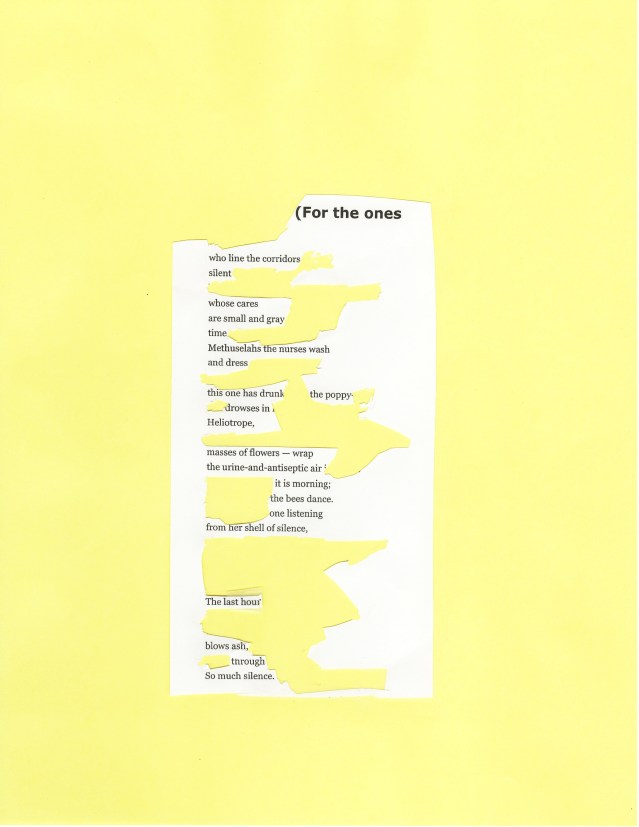
For my source document I chose an erasure poem that I created during PoMoSco, last April’s FPR challenge (well, while not strictly erased, it was cut out, which to me is effectively the same. It was done last April, and I did not go back to the original source document to make sure I was not simply filling in what was there before. It actually reads like a poem still, so I decided to leave in the line breaks rather than create a “perfectly justified prose” text as specified.  The added text is in bold italics. Below today’s piece is the poem I used for this prompt.

Heliotrope flowers

Heliotrope flowers (Wikipedia)


For the ones at Shady Valley Residence


Look first at the lonely people who line the corridors every morning
silent    through choice or the effects of illness

the frail ones whose cares are internal and entrap them
in lives that are small and gray
they just bide their time in the slow slide downhill

Methuselahs the nurses wash
and dress, no longer able to care for themselves
this one has drunk her medicine derived from  the poppy
She      drowses in the common room. Her clothing    
carries the scent of Heliotrope, an old woman smell.  

On a table vases hold masses of flowers – wrap
the urine-and-antiseptic air in a mask of roses and carnations.

The clock proves        it is morning;
in the garden   the bees dance.
but inside not one old woman is listening
from her shell of silence.

The last hour has been filled with rounds, doctors
and nurses, pills and therapy for stiff limbs
and rusty voices.

Visitors sit with family outside, one man blows ash
from his trousers, then coughs           through a haze of smoke.
Not all the residents have guests today. You can tell who,
because they sit surrounded in
So much silence.

Carol A. Stephen
April 24, 2016


My original cut-up poem shown below is titled Time Methuselahs

EPSON MFP image

EPSON MFP image