
(Photo credit: Wikipedia)
The Daily Post Challenge yesterday was to write about The Sound of Blogging, incorporating sound into one’s writing. That got me to thinking about how sound is often used as a poetic device. As I went through some of my poems to assemble a set for a poetry reading, I came across A Little Bacon and Egg Music. That’s a poem I wrote responding to a different prompt, one to incorporate natural disaster juxtaposed with unrelated elements. That was part of the Southeast Review’s 30-day writing regimen back in February. But when I came to titling the piece, it was so full of sound that it suggested music to me.
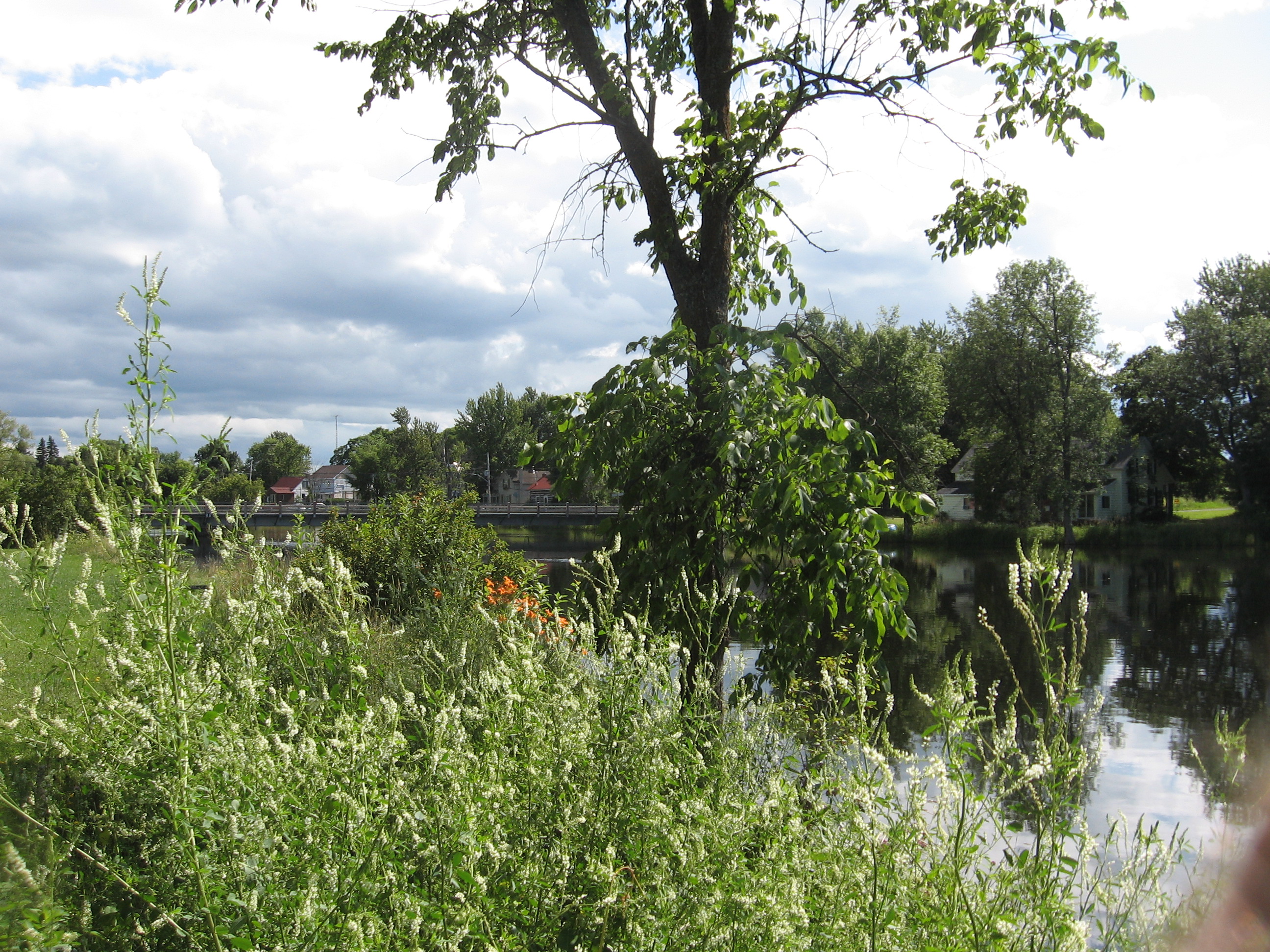
Here’s the poem (one clarification here. The Mississippi River referred to is not the one in the United States. It is the one that flows through my town, Carleton Place, Ontario.
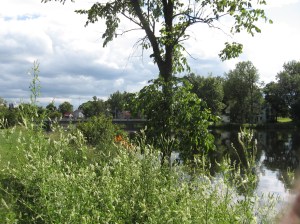
For that river, it is quite possible for a tree bridge across one of its forks) I tried to juxtapose the violent nature of a storm outside with an ordinary domestic scene at breakfast:
A Little Bacon and Egg Music
on the counter, the kettle whispers its morning boil in tune
toaster catapults crisp rye that leaps up brown and done.
spoons shiver in the sugar bowl, a subtle rustle of sound.
above the stove the wind torpedoes through the fan exhaust,
its assault thwarted so far by barriers of brick and
metal shaft elbowing round corners.
eggs bright as miniature suns gaze back at me
from where they sizzle in the pan. They cackle and spit,
a call for bacon’s smoky pizzazz, a little jazz lick.
out back, the crack and flash of lightning, as it knifes to earth,
the hoarse retort of a river oak split from leader to root into
a new bridge across the Mississippi fork.

Lightning 2 (Photo credit: Wikipedia)
It seemed a good piece to use as an example of how sound might work in a poem. Sometimes, poets use onomatopoeia, trying to mimic in words the sound the words refer to. Or, as Dictionary.com informs me:
on·o·mat·o·poe·ia [on-uh-mat-uh-pee-uh, ‐mah-tuh‐]
noun 1. the formation of a word, as cuckoo, meow, honk, or boom, by imitation of a sound made by or associated with its referent.
2. a word so formed.
3. the use of imitative and naturally suggestive words for rhetorical, dramatic, or poetic effect
In the poem, I have tried to use onomatopoeia with the words sizzle, cackle, spit, to describe the sound eggs make as they fry. And again, in the use of crack to describe lightning.
Another way sound appears in poems is through sibilance.The “sssss” sounds in a poem. In the first stanza, the kettle whispers, spoons shiver in the sugar bowl, a subtle rustle of sound.
A poet might use assonance, repeating certain vowels: For example, in the second stanza, the “o” sounds of stove, torpedoes, and so. And in the third and fourth stanzas all the “a” sounds: back, crack, flash, and again the “o” sounds of hoarse, retort, oak, and fork.
Not to be outdone, the consonants too have sound effects, referred to as, of course, consonance. The hard “k” sounds of kettle and catapult and crisp, the “p’s” of catapult and leaps. The “b’s” of barriers and brick, and later, bright and back. And my favourite two sounds that use both vowel and consonant: pizzazz and jazz.
As well as using sound for effect, word choice can convey the force of the image, so that the hard “k” sounds of words are more suggestive of the violence of the storm while the ordinary scene has more of the soft sounds that sibilance creates. (Except, of course, the catapulting toast!)





 Quillfyre