
NaPoWriMo 2016 FPR Impromptu 16 Taurid Meteor Showers

NPM-Bookmark-front-376x1024napo2016button1The prompt for today comes from Canadian poet, Christian Bök. For more about Christian, and to see other poems for this challenge please visit Found Poetry Review Impromptu #16


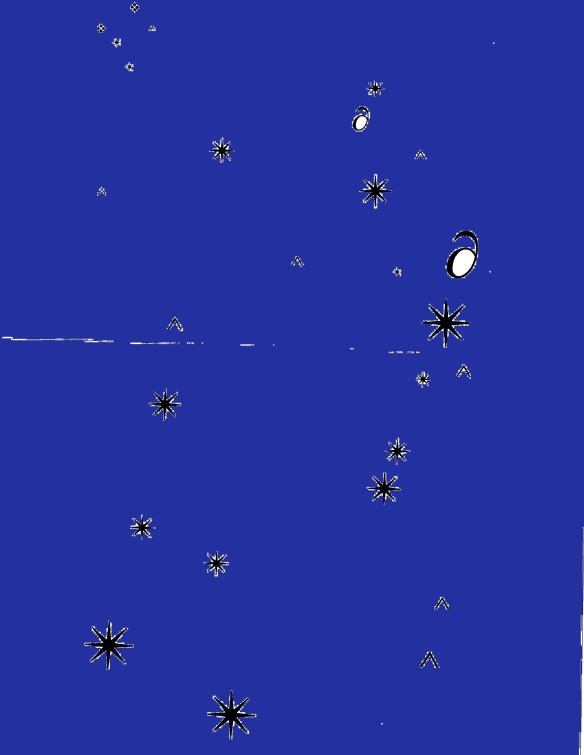
USE A TEXT TO DRAW A FIELD OF STARS.

  • Select a single page of writing from an antiquary textbook on astronomy.
  • Scan this page, using customary software for manipulating photographs.
  • Erase all text from the image, leaving behind only the punctuation marks.
  • Assign to each punctuation mark, a specific style of dot, bullet, or asterisk.

For example:

         ,      =      •
         .      =     ✦
         ;      =     ✹
         :      =     ★
         —   =     ☉

  • Replace each punctuation mark with the specified bullets from your cipher.
  • Vary the point-size of each asterisk, according to the number of letters in the word originally preceding the punctuation (for example: 1 letter = + 0.5 pts).
  • Change the colour of the background to black; change each mark to white.
  • Connect some of the largest dots by drawing lines to make a constellation.
  • Identify the starfield, using the title of the book (and the page number cited).

It took awhile to locate a source, since I have no access today to antiquaries or astronomical treatises other than via the internet.

Although I have used photo editing tools for erasures and blackouts, I am essentially one of the unwashed when it comes to this kind of stuff.  Due to various complications along the way: no white font, a rather rough looking image.

Taurid Meteor Showers
Taurid Meteor Showers_0006


Source http://www.davidchandler.com/2015/11/09/taurids-meteor-showers/

NaPoWriMo 2016 FPR Impromptu 15 Nothing Left

NPM-Bookmark-front-376x1024napo2016button1

FPR Impromptu 15 Love What You Hate   Joel Katelnikoff

In this technological era of direct textual manipulation, we must always acknowledge our own agency as readers. If we hate a text, we may no longer blame the text. Instead, evaluate the text with a particular eye for discovering, within it, that which you can love. Because the thing has not failed you. Rather, you have failed.


Instructions:

Reread the last book that you’ve hated, committing yourself to love it.
Do not expect to experience this love in a linear and continuous manner.
Read quickly, ignoring every element of the text that you might detest.
Flag every element of the text that you are capable of appreciating.
Transcribe all flagged materials.


Not a book I hated, but one I had set aside as a difficult read. A book of essays, some about poetry, others about other forms of writing outside my interests or range of reading. I’ve chosen to select text from Edge, Essays, Reviews, Interviews, by Mary Dalton, (pp. 178-182, 185-186) a Newfoundland poet whose work I greatly admire.  This is from her discussion of the Boatman series of paintings by Newfoundland artist, Gerald Squires.  This exercise has given me a different way to approach the essays when I resume reading it in the next week or so.  It also made me realize that the difficulty is mine, and is one of focus (and that I should not try to read a book with the television on, volume turned down or not).

English: Sea angel (Clione limacina).

Sea angel (Clione limacina) (Wikipedia)


Nothing Left


The figure hovering
chaotic and ill-formed
a smashed skull

within this mass
the tumult of water
an angel crying out in

the otherworld of corkscrew forms
the spiral evolution of universe
flux beneath the sea

a fish rides the great wave
all ribs and bones
nothing left but its sound

and the wild waters
drowning the moon


English: Cartoon drawing about a big fish bein...

a big fish (Wikipedia)

Carol A. Stephen
April 15, 2016

NaPoWriMo 2016 FPR Impromptu 14 14 Lines, Chocolate-Coated

NPM-Bookmark-front-376x1024glopo2016button1

For April 14, the Found Poetry Revew prompt is from Brian Oliu.

It’s a little like Wildminding and a little researching, but from within, as you examine in detail what you want to write about.  Brian says it better though:

Set aside about twenty minutes of your day with the intention of “doing research” for a piece. Do not allow yourself to write about anything that you do not experience firsthand: if you are writing about the feel of water, or the taste of an orange, run your hand underneath the sink or get to the supermarket as soon as possible. Allow yourself to be immersed in your project & only trust “first hand research” instead of cobbling things together from various sources/the Internet–it will be there later for second drafts. If you are writing about a scene in a movie, watch that scene. If you are writing about a trip that you took, try your best to replicate that trip to the best of your abilities. Take notes, but don’t let the notes dictate your experience. After you have concluded your “research” begin writing immediately & without prejudice–don’t stop, don’t worry about linebreaks or punctuation, or word choice: capture whatever fleeting magic you have conjured until the feeling is gone.

To read more about it, and to read about Brian, as well as the poems from other FPR Challenge participants: FPR Impromptu 14 

At first, this sounded rather complex, but as I thought about it, while eating a Cadbury’s Dairy Milk Fruit and Nut Bar, I realized how it was going to work!


14 Lines, Chocolate-Coated


Anticipation. The wrapper rustles, resists
downward pull on paper, corner-torn and open—

the flat brown of chocolate impatience and a second tear
pulls the paper free. One square at a time slides onto tongue.

Instant warmth and saliva melt the surface, teeth feel resistance
as almond remnant cracks free to float a moment in the mouth,
joined next by wrinkle of raisin, the next solitary square.

Each melt of chocolate sets tongue tingling, anticipation still–
for the next and the next and the last, leaving only a vague

memory of how it soothes touch, taste, scent. Only sound and sight
not satisfied by the mere proximity of a bar of chocolate.

Short-lived. In a moment or two the lingering taste fades
to less than memory. And now the struggle to resist attacking
the second beckoning bar.


A chocolate bar and melted chocolate. Chocolat...

A chocolate bar and melted chocolate. Wikipedia

Carol A. Stephen
April 14, 2016

NaPoWriMo 2016 FPR Impromptu 13 Nobody Tells You About Circus Wagons

NPM-Bookmark-front-376x1024glopo2016button1Today’s (April 13) prompt from Found Poetry Review comes from another Canadian poet, Sennah Yee. To read more about Sennah, and to read the other poems from participants, visit the FPR site here. 

The prompt itself is quoted below:

Wanderlust

Travel websites have always intrigued me with their language—visual, lush, and sometimes a bit dramatic and naive. Browse travel websites and write down any words/phrases that interest you: descriptions and/or customer reviews of resorts, landmarks, attractions, hotels, restaurants, etc. Craft a poem using only these words/phrases. You may arrange them in any way you wish. Here are some sources to get you started:

TripAdvisor’s Top 25 All-Inclusive Resorts
TripAdvisor’s Top 25 Beaches
TripAdvisor Travel Inspiration

The sites I used are shown below the poem, which is drawn from three travel sites and several articles, then remixed.


Nobody Tells You About Circus Wagons – Self-Catering Ain’t What it Used to Be


You have to carry a 70 pound suitcase full
of everything in your room at home. You regret
cobbled streets in Europe, anything with wheels,
a longtail and a beach in Cambodia.

English: Longtail boat on the shore of Phiphi ...

Longtail boat (Wikipedia)


Glamping is the way forward through rice fields
from canvas pavilions and yurts.
Who knew free breakfasts would become
the things that don’t fit anywhere else?

Free Wi-Fi might only be in hidden and zippered pockets.
It’ll immediately go down. Breakfast becomes your highlight:
eat as much as possible, sneak a couple of rolls into the world’s
worst airport, a piece of work hellhole, a decaying hulk.

Terminally congested passengers exit directly onto land
shaped like an arrow reclaimed from the sea; the old city
a painless skybridge of yellow.  A masochist flag carrier was
assassinated on the  tarmac in 1983,  collapsing like a bad smell.

You get fed up with talking. It’s never pleasant. Conversations
revolve around the same five questions.
There’ll always be a creepy guy there in a dark corner watching
in silence. The old man in Hualien, in Taiwan greeted me with,
Don’t worry: I’m not a sex pest. I wanted to change rooms.

You expect the snorers, the occasional dodgy bathroom.
You wake up in the middle of the night to the sound
of throwing up in the middle of the room, not just vomit.
All kinds of bodily fluids have been expelled.

Integrate immersion through the language using writing and yoga
as touchstones. Desert camels wash in the sink with shampoo
and dry overnight.

Waiting time between footsteps can be slow in San Miguel de Allende.
The ancient burial site is the entrance to Starbucks, the streets
for thousands of years constructed by the Otomi dolls.
They don’t take up much room in a suitcase.


English: Gato Negro Cantina in San Miguel de A...

San Miguel de Allende, Guanjuato, Mexico ( Wikipedia)

Carol A. Stephen
April 13, 2016

Sources:  About.com/travel, NomadWomen.com, Journeywoman.com

a longtail is a type of watercraft native to Southeast Asia