Using Sound Elements in Poetry: A Little Bacon and Egg Music

English: Bacon and Eggs frying on an electric ...

(Photo credit: Wikipedia)

The Daily Post Challenge yesterday was to write about The Sound of Blogging, incorporating sound into one’s writing. That got me to thinking about how sound is often used as a poetic device. As I went through some of my poems to assemble a set for a poetry reading, I came across A Little Bacon and Egg Music. That’s a poem I wrote responding to a different prompt, one to incorporate natural disaster juxtaposed with unrelated elements. That was part of the Southeast Review’s 30-day writing regimen back in February.  But when I came to titling the piece, it was so full of sound that it suggested music to me.

Here’s the poem (one clarification here. The Mississippi River referred to is not the one in the United States. It is the one that flows through my town, Carleton Place, Ontario.
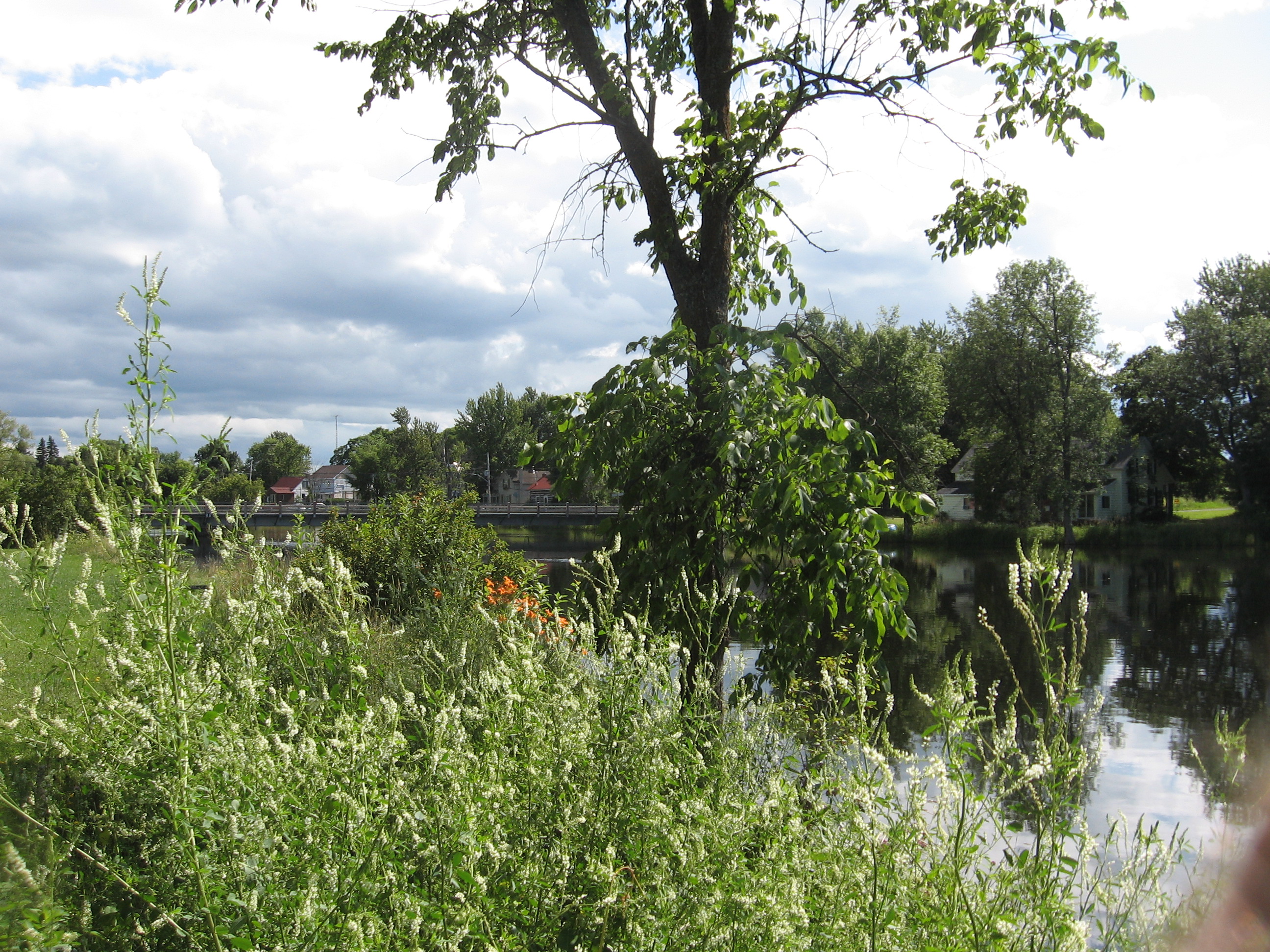
For that river, it is quite possible for a tree bridge across one of its forks)  I tried to juxtapose the violent nature of a storm outside with an ordinary domestic scene at breakfast:

A Little Bacon and Egg Music

on the counter, the kettle whispers its morning boil in tune
toaster catapults crisp rye that leaps up brown and done.
spoons shiver in the sugar bowl, a subtle rustle of sound.

above the stove the wind torpedoes through the fan exhaust,
its assault thwarted so far by barriers of brick and
metal shaft elbowing round corners.

eggs bright as miniature suns gaze back at me
from where they sizzle in the pan. They cackle and spit,
a call for bacon’s smoky pizzazz, a little jazz lick.

out back, the crack and flash of lightning, as it knifes to earth,
the hoarse retort of a river oak split from leader to root into
a new bridge across the Mississippi fork.

Lightning 2

Lightning 2 (Photo credit: Wikipedia)

It seemed a good piece to use as an example of how sound might work in a poem. Sometimes, poets use onomatopoeia, trying to mimic in words the sound the words refer to.  Or, as Dictionary.com informs me:

on·o·mat·o·poe·ia   [on-uh-mat-uh-pee-uh, ‐mah-tuh‐]

noun 1. the formation of a word, as cuckoo, meow, honk,  or boom,  by imitation of a sound made by or associated with its referent.

2. a word so formed.

3. the use of imitative and naturally suggestive words for rhetorical, dramatic, or poetic effect

In the poem, I have tried to use onomatopoeia with the words sizzle, cackle, spit, to describe the sound eggs make as they fry. And again, in the use of crack to describe lightning.

Another way sound appears in poems is through sibilance.The “sssss” sounds in a poem. In the first stanza, the kettle whispers, spoons shiver in the sugar bowl, a subtle rustle of sound.

A poet might use assonance, repeating certain vowels: For example, in the second stanza, the “o” sounds of stove, torpedoes, and so. And in the third and fourth stanzas all the “a” sounds: back, crack, flash, and again the “o” sounds of hoarse, retort, oak, and fork.

Not to be outdone, the consonants too have sound effects, referred to as, of course, consonance.  The hard “k” sounds of kettle and catapult and crisp, the “p’s” of catapult and leaps. The “b’s” of barriers and brick, and later, bright and back. And my favourite two sounds that use both vowel and consonant: pizzazz and jazz.

As well as using sound for effect, word choice can convey the force of the image, so that the hard “k” sounds of words are more suggestive of the violence of the storm while the ordinary scene has more of the soft sounds that sibilance creates. (Except, of course, the catapulting toast!)

No-Comfort Zone Week Ending Aug. 26

So, what did I achieve this week that was outside my comfort zone?  I suppose a few things, although some of them are getting to be more comfortable. For instance,  I was one of several featured readers at the Ontario Poetry Society event in Ottawa yesterday, to continue the launch of my second chapbook, Architectural Variations. But readings are getting more comfortable.

On Saturday, I attended the Plan 99 North event in Wakefield, held as part of Wakefest, Wakefield’s annual art festival. There I actually joked with two of the three featured readers, including Ken Babstock, this year’s Griffin prize winner. Not long ago, I wouldn’t have had the nerve to do that.

I also realized, on discussing ideas for new projects that I have in mind, that they might actually be workable ideas. While I haven’t forgotten that I want to get back to my goal of submitting more to litmags, this is actually going to fuel that too, as I go back over earlier poems that are still lying around, not yet quite “done”.  I’ve recently been filing my revisions of the poems in the new chapbook, and happened across a number of poems that I had forgotten all about. They would fit quite nicely with the new projects, with a little attention.  And books that I want to read as research into these endeavours. Not ready though, to share the “what”.

And I have realized that sometimes I set myself up to fail at things by overplanning and trying to put self-improvement techniques into play that just add stress when I can’t quite manage the “one more thing” they represent.  So. That is a breaktrhrough too, of sorts.


Carol

No-Comfort Zone Week ending Aug. 19

This past week, I suppose the biggest breakthrough for me was as a featured reader at Tree Reading Series.  I think it was the wonderful commentary

open mic host: Rod Pederson

open mic host: Rod Pederson (Photo credit: pesbo)

by Rod Pederson as he introduced me that made me so relaxed, because at one point I leaned my arm casually against the lectern as if I had been there all my life. (Well, not ALL my life…)

I launched my second chapbook as well, which was another push forward with my poetry, so I was most pleased about that too.

I don’t mean to go on and on about this event, but it really is quite a nice honour to be selected as a Hot Ottawa Voice. And congrats on that to my fellow hotties, once again, David Blaikie, Shai Ben Shalom, and Guy Simser.

Here is a link to my reading that night.  http://www.treereadingseries.ca/videos/featured-readers/carol-stephen-14-aug-12

You can also access each of the other readers at the Tree Reading Series site, under Videos.

http://www.treereadingseries.ca/videos

Saint Patrick’s sister voices her opinion

For the Thursday Treat prompt at imaginary garden with real toads:


Saint Patrick’s sister voices her opinion

Statue of St. Patrick in Aughagower, County Mayo

Statue of St. Patrick in Aughagower, County Mayo (Photo credit: Wikipedia)

What can one say about a brother?

Everyone knows
they are not saints.
Patrick was no different,
although time and its passing
have made him so.

The truth of it?
There were no snakes
on the island.
How would they have come?

Patrick would not
have driven them out,
he would have sat down
to tea and crumpets, a peat fire,
perhaps a wee whiskey
and blarneyed the snakes
into swimming to France.
Yes, so he would!

A poet, a charmer,
but no saint.
He was Irish, after all.
And that’s the truth of it.

Carol A. Stephen