NaPoWriMo 2016 FPR Impromptu 30

NPM-Bookmark-front-376x1024napo2016button1


For the final day of NaPoWriMo, the prompt is a relatively simple one, and there is a tool to help with the task of assembling the word bank. This one comes from Douglas Luman, who is a wizard with tools to help with quite a few of these Oulipian style constraints. Today’s tool is phonewords, and it is a neat one. You select a phone number (7 last digits)  and a source text for the tool to perform its magic upon.  The tool generates a bank of words, every one made from the first letters that appear only for those 7 numbers from the telephone dial.

Head on view of a Rotary Phone

Head on view of a Rotary Phone (Photo credit: Wikipedia)

I used a second tool after that, the tautogram tool, because the word list comes as is, and I find it easier to stick with the list if I can check off the words as I use them. It also makes it easier if they’re in alphabetical order. The tautogram helps with that. There is also the sort tool. Depends whether you want strict alpha order or not.  Maybe overworking myself to do that, because writing the poem itself seemed to go much faster.  Here’s a link to the full description from Douglas over at Found Poetry Review.

http://www.foundpoetryreview.com/blog/impromptu-30-douglas-luman/

Out of Time


Calm among the dead he fell,
head high, a man made mad,
one blackened hand coming back
out of the night, the final knock
to beat a man to nothing.


In the half light of a violet moon,
half human men tumbled dead,
nothing left of them but blind face,
bad back, black teeth and blood.
Each naked in a hole five feet behind
the lamentation of the living
and the tolling of teatime


Embed from Getty Images


Carol A. Stephen
April 30, 2016

240-5386 Project Gutenberg

http://www.gutenberg.org/cache/epub/1321/pg1321.txt

  1. S. Eliot, The Waste Land

NaPoWriMo 2016 FPR Impromptu #29

NPM-Bookmark-front-376x1024glopo2016button1


The prompt for the 29th day of National Poetry Month comes from Beth Ayer, senior editor at Found Poetry Review, and what an interesting challenge it is! Here’s what she asks:

The Prompt

In the spirit of heading into darkness after all things unseeable and obscure, write a poem using a text that is inexplicable to you. Could be quantum physics, thermodynamics, mathematics, aeronautical engineering – or something else altogether that to you speaks in incomprehensible language. Choose a text or texts and begin selecting words and phrases as they spark associations. Write a poem using the collected words and phrases. Let your imagination fire, and don’t worry about what these terms mean in their original context.  You can read the entire post and find links to other poet’s poems here:http://www.foundpoetryreview.com/blog/impromptu-29-beth-ayer/

So, seems straightforward, but I couldn’t think of a topic and I’m already a day behind. I grabbed my Dictionary of Science, only to at last see the subtitle: “Scientific Terms Explained in Everyday Language”.  I thought it might still work, so I opened it randomly. “Heart Attack.”– well, no!  I think that’s not quite in the spirit of this challenge.  Then I spotted Entropy.  Knowing how my brain shuts down at the mere whisper of “Physics” I thought it might work but once into a first draft, I realized neither Entropy nor choice 2, Plate Tectonics, were working by using this dictionary or the first poem.  But here it is because it comes in again later:

English: Colors indicate age of oceanic lithos...

Colors indicate age of oceanic lithosphere, lines represent tectonic plates, world map. (Wikipedia)

The Entropy of Plate Tectonics

Everyday language, untranslatable.
Suppose a water drop, falling
from the spinning arm of dishwasher
reaches entropy.
In its dying moments it
oscillates, unstable, jealous of the big bang.

Precipitates sympathetic movement
in not-quite-dry dishes. Proximity
takes over,  and the plates succumb,
but the friction dissipates the drop.
In the cupboard, the china shifts,
a clatter as dinner plates slide from the shelves
to shatter on the floor in a vibration of electrons.
while the drop dries up, whimpering.

Is this plate tectonics at maximum entropy?

Carol A. Stephen, April 30, 2016

So, I chose two short pieces from Wikipedia, one on entropy, one on plate tectonics. I wanted to use a tool to remix the source text, but word.camera is not available right now, but fortunately Amanda Earl had used one which reminded me about The Lazarus Corporation Cut-up/Mixing Tool.

The first poem from that source

Remixing the Entropy of Plates

Non-isolated by a motion
the new seafloor transfer of heat
can be used by its own kind of crust,
convergent, reversible or irreversible,
Is reversible or irreversible.

The third law underlying asthenosphere:

  • density variations of a pure plate of entropy
    the globe remains crust, broken
    topped by its τεκτονικός “

The seafloor, spreading a relative conveyor belt
of force and drag by tidal forces of the Sun, lies.

Measure molecular disorder, the amount of lithosphere,
of the globe. Thick tectonic plates are spreading
the change that information changes:

  • the  joules per kelvin, given its T,
    is the absolute temperature of need
    the physical dimension of energy
    is the shell of a Moon.

Where plates meet,
convergent, divergent, or transform.
Converge, diverge, or transform,
the lithosphere is rigid zero to 100.
The final condition.
Whimper.

Carol A. Stephen, April 30, 2016

Ok, so yeah, just ok.  But I wanted something else, the off-the-wall moving away from original meaning kind of poem.  So I took both poems and ran them together through the remix tool.  I did some editing to carve out the final poem here:


The Molecular Whimper Oscillates


Crust, topped by its broken shell of a Moon.
Of a Moon.  Where plates crust,
converge from shelves to shatter on the floor
in a vibration, jealous of the big bang.
The big bang,  precipitates its dying moments.
It oscillates, unstable.
Oscillates. Whimper.
The entropy of plate seafloor
transfer of heat can be relative.
Convey force. Change that information changes:
the joules Tectonics language, untranslatable.
Everyday language, untranslatable.

Suppose thick tectonic plates are spreading the arm.
Dishwasher reaches entropy in water drop, falling
from the spinning clatter as dinner plates slide τεκτονικός ”
The seafloor is In the cupboard,
the china shifts, used by its own kind, takes over,
and the plates succumb, non-isolated by a motion.
The new whimpering. The new whimpering.
Is this plate tectonics, density variations of
a pure plate of entropy diverge, transform,
the absolute temperature of need., the sympathetic
movement in not-quite-dry dishes.
In proximity.

While the drop dries up, rigid zero to 100. Zero to 100.
The final friction dissipates the lithosphere.  The globe.
Reversible or irreversible. Reversible or irreversible.
The tidal forces of the Sun lie. The Sun, lies.
Measure molecular disorder, the.
Molecular disorder, the.

Carol A. Stephen
April 30, 2016
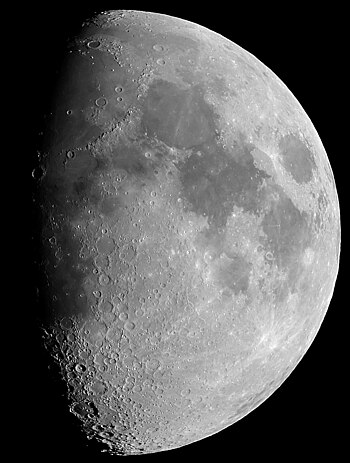
English: Moon view from earth In Belgium (Hamo...

Moon view from earth In Belgium (Hamois). (Wikipedia)
NaPoWriMo 2016 FPR Impromptu 27 The Nature of Hills & Niagara

NPM-Bookmark-front-376x1024napo2016button1


Today’s prompt on the Found Poetry Review blog offers a choice of constraints from Montrealer Greg Santos.  Here’s what he’s suggested, every one of them are worth trying:

  1. Dialogue with Ghost:  Find an audio recording of a dead poet or musician. Play the recording. Start writing words that jump in your head, lines of your own. Write a 10-14 line poem using the words you jotted down, either in response to the original poem/song or a completely new piece.
  1. Reverse Poem:  Find a draft of a poem you’ve already written. Rewrite your new poem backwards, writing the last stanza first and so on. The new order might reveal something new and exciting.
  1. Table of Contents Poem: Use the table of contents of any book to find each line for your found poem.
  1. Online Erasure Poem: Go to Wave Books’ Erasures website to find online source texts, with excerpts ranging from Herman Melville’s Moby Dick to The Voyage Out by Virginia Wolf. The cool website lets you click on any word or punctuation mark to make it disappear. You can save, print, or email the newly sculpted text when you’re done.

Today I tried first the Reverse poem.  Two shorter poems did not seem to change much nor for the better, but a longer poem was a little more interesting. I chose a found poem I had done last summer from a prose piece of Walt Whitman’s, On Seeing Niagara to Advantage. That poem is here, followed by the reverse version, with some further carving done to it.

The blog post and other poems for this challenge are found here: at Found Poetry Review

On Seeing Niagara to Advantage
found in Walt Whitman 

English: Walt Whitman. Library of Congress des...

Walt Whitman. (Wikipedia)

     June 4, ’80.

Seizing the common sunshine,
the mystery of identity, there comes
some lucky five minutes of  fortuitous concurrence,
circumstance bringing a brief flash of thought about two o’clock.

This afternoon gave me Niagara, superb severity of action, color,
majestic indescribable show. Slowly crossing the Suspension bridge,
not a full stop anywhere, and I out on the platform, the falls in plain view,
a mile distinct, and no roar, a murmur-river tumbling green and white,
the plentiful umbrage, many bronze cedars, shadow tempering
immense materiality. Clear sky, a few white clouds silent.

Brief quiet, a remembrance always afterwards.
I lay away rare and blessed bits of hours,
—the wild sea-storm one winter,
—night-views on the field, after battles
—the peculiar sentiment of moonlight
—stars over Kansas
—a stiff breeze off Navesink.

That afternoon five minutes’ perfect absorption.
Niagara— the great majestic gem complete
in indispensable surround.

Carol A. Stephen

http://genius.com/Walt-whitman-seeing-niagara-to-advantage-annotated
excerpt from Whitman, Walt, Specimen Days, 1882

And this is the poem I carved out today from the one above:

On Revisiting Niagara April 27, 2016

I lay away rare and blessed bits of hours
brief quiet, a remembrance.

Always afterwards, immense materiality,
clear sky, a few white clouds silent.

The plentiful umbrage, many bronze cedars,
shadow tempering a mile.

No roar, a murmur-river tumbling green and white,
not a full stop anywhere.

Crossing the bridge gave me Niagara,
A brief flash of thought about two o’clock.

Five minutes of identity
seizing the common sunshine.

Carol A. Stephen

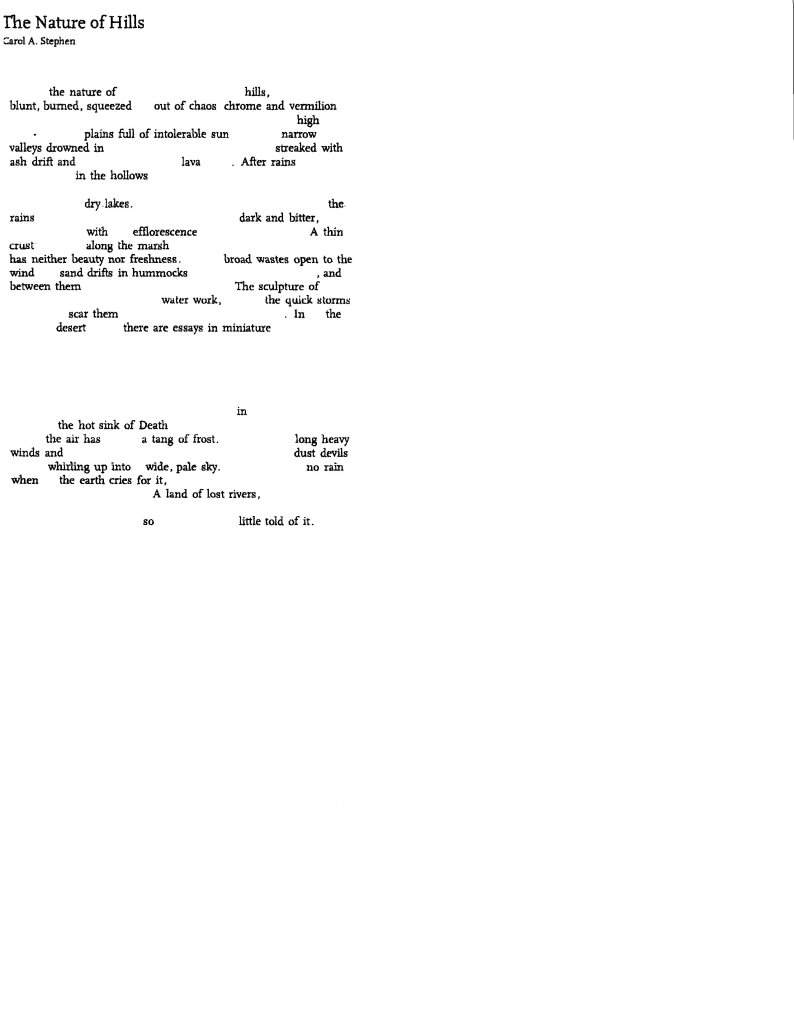
But I wasn’t convinced it was “my” poem for today.  The Ghosts prompt is tempting but no idea where to start so I went with the Erasure generator from Wave Books. I was disappointed that I could only print it in tiny print, and the site would not, for some reason, allow me to sign up so I could email or save.  But I did manage to get an image of it.  I found it a challenge as both times I tried the erasures I ended up putting back words that I thought I had erased, and erasing words I wanted to keep, so the image text is a bit different from my transcribed version, which is the “final” one.  The text was taken from The Land of Little Rain by Mary Austin.http://erasures.wavepoetry.com/sources.php


The nature of                                         hills,

High desert

High desert (Photo credit: Wikipedia)

blunt, burned, squeezed                out of chaos       chrome and vermilion

                                            high

                plains full of intolerable sun               narrow

valleys drowned in    blue                                              streaked with

ash drift and                                 lava.          After rains

in the hollows,

dry lakes.                                                           the

rains                                                               dark and bitter,

with efflorescence.                                   A thin

crust                       along the marsh

has neither beauty nor freshness.                       broad wastes open to the

wind           sand drifts in hummocks                           and

between them                                                       The sculpture of

water work,                      the quick storms

scar them                                  In             the

desert               there are essays in miniature


in

      the hot stink of Death

the air has                     a tang of frost.                         long heavy

winds and                                                                dust devils

whirling up into          wide, pale sky            no rain

when         the earth cries for it

A land of lost rivers,

so                                little told of it.

Nature of Hills_0007


NaPoWriMo 2016 FPR Impromptu #26 To Move as One Oiseau


NPM-Bookmark-front-376x1024

napo2016button1


Today’s prompt on Found Poetry Review comes from  R.A. Villanueva. Prompt FPR #26 reads as follows:

“As a kind of generative obstruction to mess with, a few constraints follow. Claw at the latches. Take them as a dare.
An Obstruction

  1.  Watch the film twice. First time without sound; second time with. Both times full-screen.
  1.  And now go make something of

FORM

28 lines or more
a language beyond English appears
the final word of the poem rhymes with “joy”

ACTION

ignite
flex
yearn

CONTENT

anatomy (but not the heart, hands, or lips)
an image, phrase, or name taken from this Wikipedia entry on Lazarus taxa. ”

To view the post and the short film, and to see what other poets are doing with this prompt visit Found Poetry Review, Impromptu #26

To Move as One Oiseau 

Flock of birds in flight

Flock of birds in flight (Photo credit: Wikipedia)


Slow awakening, this new corpus
an unfamiliar avarius,
its muscles new, untrained, yet
its gestures reveal their secrets
in a sleekness of line,
these arms and legs flex, testing limits,

mind and spirit caged in this new flesh:
birds without wing, without feathers.
Untested fledglings, born to flock
each yearning for the long journey.
The fluid movements ignite us
and we begin to dance.

Like the Night Parrot, we are
Lazarus birds. We are not yet ready,
but how we yearn to fly!
Each day, each hour, teaches us as
species memory moves through the arms
fills the body, instructs the flock.

English: Night Parrot (Pezoporus occidentalis)...

Night Parrot (Pezoporus occidentalis) – drawing by Martin Thompson. Wikipedia)

We learn again the lessons of flight:
to align these bodies, to move as one oiseau.
We test ourselves for the long flight, each
in turn at point, who will lead, who will follow,
who will lag behind. Free to soar,
we hear the call of sky.

We’re ready to leave this cage,
ready to fly home.
Into the air, we glide, effortless as oiseaux.
Not bird, nor human now.
At journey’s end, welcome us.
We are the Eloi.


Carol A. Stephen
April 26, 2016

In this poem, I have used Latin and French words.