
NaPoWriMo 2016 Day 25 Stone Sonnet FPR Inchworm

NPM-Bookmark-front-376x1024glopo2016button1


Today’s prompt is the one from NaPoWriMo.net

And now for our (optional) prompt! Today, I’d like to challenge you to write a poem that begins with a line from a another poem (not necessarily the first one), but then goes elsewhere with it. This will work best if you just start with a line of poetry you remember, but without looking up the whole original poem. (Or, find a poem that you haven’t read before and then use a line that interests you). The idea is for the original to furnish a sort of backdrop for your work, but without influencing you so much that you feel stuck just rewriting the original!. For example, you could begin, “Shall I compare thee to a summer’s day,” or “I have measured out my life with coffee spoons,” or “I miss them, but it wasn’t a disaster,” or “they persevere in swimming where they like.” Really, any poem will do to provide your starter line – just so long as it gives you the scope to explore. Happy writing!

My first line is taken from the poem Rock Me, Mercy, which is from Yusef Komunyakaa’s collection, The Emperor of Water Clocks, his new collection that I am currently reading.

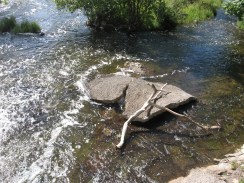
stones pic 2 for blogStone Sonnet

The river stones are listening
to gossiping willows swaying low
to whisper in the river’s ear.
The river doesn’t hear them,
its own chatter over the stones
drowns the softer sound of rustled leaf.


The river stones hear it all, the whispers,  IMG_0219
the sharp warning calls as crows
announce the coming of each
brush wolf and every hungry cat.
Even the shotgun blast,
the single croak, the death rattle.


The stones, stoic, voices caught fast in granite hearts—
forever silent, forever listening.


Carol A. Stephen
April 25, 2016


But I did try the FPR Impromptu 25 prompt to do a homophonic translation. This prompt came from Nancy Chen Long.  I’ve done this exercise before and liked this result. This time, I think too late in the day, as I could not quite find something that worked well. But… see for yourself!   To read the orginal poem in both Corsican and English, by Patrizia Gattaceca  Poems in Corsican  http://www.poetryinternationalweb.net/

The poem is called Inchjostru translated as Ink. I have not included it here. My poem attempt appears below the prompt description.

Prompt

from Found Poetry Review: This prompt is the homophonic-interpretation one that I mentioned in my introduction. It involves reading a poem in another language that you do not speak. The language of the poem you select must be one in which you don’t know what’s being said, so that your imagination has greater room to play. If you know what is being said, then that knowledge might constrict your imagination too much.

Find a poem in its original language. You can use Google for this. For example, entering the phrase “poems in french” into Google brings up the two links below, each of which show poems in their original French. (One of them also shows poems in Vietnamese as well). However, both links also show a translation into English—don’t read the translations!

http://www.poetrytranslation.org/poems/in/french

http://thehuuvandan.org/lit.html

If this is your first homophonic interpretation, then a selecting a shorter poem is probably better.

Sound out the poem and “translate” it based on what you hear. A couple of methods you can use to sound out the poem are:

To sound out the poem aloud by yourself. This might be doable if the alphabet being used is something you can sort-of recognize.

And/or use Google Translate (https://translate.google.com/ ): Paste in a line or phrase or word of the poem in its original language. Select the language to be translated if Google doesn’t recognize it. Once the language has been detected, a little speaker icon should appear below the text you pasted in. Click the speaker icon and Google voice will read what you entered back to you.

Of course, your translation won’t be exact—getting words anywhere near the ballpark of what you think you hear is good.


Inchworm 

Chenille sur une branche

Chenille sur une branche (Photo credit: Wikipedia)


The inchworm gyrates in its blood,
strange visitor inside
the goats you dream. Pursue
water, your earthly body,
dead from the sea.
Salt revives you.

The Old Mother
at first night
chanting in tongues,
offers forth a pear
to release you from the worm’s spell.

Its silence means farewell;
you inhale the evening air.

The inchworm departs
chanting in tongues.

CAS

NaPoWriMo 2016 FPR Impromptu #24 For the Ones at Shady Valley Residence

NPM-Bookmark-front-376x1024napo2016button1


Today’s FPR prompt Day 24 comes from Craig Dworki, quoted here:

I am most often interested in seeing what language can do that it didn’t know it could do — in finding the imaginary solutions to questions we never thought to ask. Rather than seek le mot juste — the right word to convey some meaning — I am usually more inclined to see what meanings might arise from materially structured language (“where once one sought a vocabulary for ideas, now one seeks ideas for vocabularies,” as Lyn Hejinian put it). What, I try to ask, does language itself want to convey when given the chance? The hardest part of the task is being quiet enough to listening closely.

Take an erasure poem (FPR is full of them) and then add words to fill in the empty spaces in order to create a new text that flows naturally and coherently. Words should fit exactly — to the letter — so that the result appears to be perfectly justified prose. Don’t cheat by kerning.

You can see the full post and other poems here: http://www.foundpoetryreview.com/blog/impromptu-24-craig-dworkin/

For my source document I chose an erasure poem that I created during PoMoSco, last April’s FPR challenge (well, while not strictly erased, it was cut out, which to me is effectively the same. It was done last April, and I did not go back to the original source document to make sure I was not simply filling in what was there before. It actually reads like a poem still, so I decided to leave in the line breaks rather than create a “perfectly justified prose” text as specified.  The added text is in bold italics. Below today’s piece is the poem I used for this prompt.

Heliotrope flowers

Heliotrope flowers (Wikipedia)


For the ones at Shady Valley Residence


Look first at the lonely people who line the corridors every morning
silent    through choice or the effects of illness

the frail ones whose cares are internal and entrap them
in lives that are small and gray
they just bide their time in the slow slide downhill

Methuselahs the nurses wash
and dress, no longer able to care for themselves
this one has drunk her medicine derived from  the poppy
She      drowses in the common room. Her clothing    
carries the scent of Heliotrope, an old woman smell.  

On a table vases hold masses of flowers – wrap
the urine-and-antiseptic air in a mask of roses and carnations.

The clock proves        it is morning;
in the garden   the bees dance.
but inside not one old woman is listening
from her shell of silence.

The last hour has been filled with rounds, doctors
and nurses, pills and therapy for stiff limbs
and rusty voices.

Visitors sit with family outside, one man blows ash
from his trousers, then coughs           through a haze of smoke.
Not all the residents have guests today. You can tell who,
because they sit surrounded in
So much silence.

Carol A. Stephen
April 24, 2016


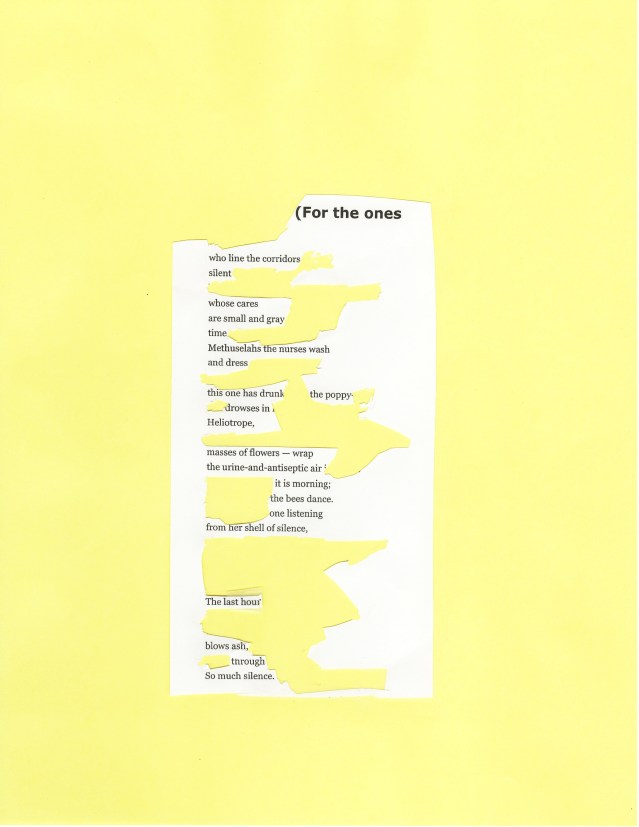
My original cut-up poem shown below is titled Time Methuselahs

EPSON MFP image

EPSON MFP image


NaPoWriMo 2016 FPR Impromptu 23 For the Field Stone Poets

NPM-Bookmark-front-376x1024napo2016button2


Today’s prompt goes back once again to the Found Poetry Review’s blog, and the post by Daniel Levin Becker, who is a member of the French Oulipo group of writers and mathematicians. He gives us his variation on an Oulipo form, the petit récapitul portatif.  It’s a rather lengthy set of instructions, but actually quite straightforward as you begin to work with it. Time constraints today (income tax deadline approaching!)  meant I went with the first things that each random article suggested to me but this method definitely will be one I revisit.  You can view the full post and links to other poems here

1. The poem consists of 10 lines total, in a 3-3-3-1 stanza distribution.
2. Each line is 9 syllables long. No meter is required.
3. The lines do not rhyme.
4. After each three-line stanza comes a list, in parentheses, of three words taken from one of each of the lines in the preceding stanza.
5. The poem is dated and addressed to a specific person (someone you know or someone you don’t).

Here’s how we’ll use it:
6. This link will direct you to a Wikipedia article in English, chosen at random. (You can also click on the fifth link down on the lefthand toolbar of any article.)
7. The first line in your poem will correspond to the first random article you see, the second to the second, and so on for all ten lines.
7a. You may replace up to two of your random articles with either a new random article or an article one click away from the original.
8. You may interpret “correspond to” however you choose. You can quote the article, paraphrase it, comment on it, take impressionistic inspiration from it, or what have you.
9. You may open ten random articles at once and plan out the content of your PRP, though still observing the order in which you opened them; you may also complete each line of the poem before allowing yourself to open the next article.
10. If you so choose, hyperlink each line—or the list word taken from it—to the corresponding article.

I was surprised at how the articles for the first few searches were about people and places so close to home, starting with a French school in Ottawa. In selecting articles I did make two substitutions where they were really short stubs and going far afield from where I was going with the poem. (Croatian nobility from the 1200’s for instance).  Starting then, with Ottawa, I considered each article for how they might tie in some way to the city.  Rather than dedicate to a single person, this piece is addressed to my Ottawa poetry group, The Field Stone Poets, Sylvia Adams, Gill Foss, Glenn Kletke, (sometimes Karen Massey) and Margaret Zielinski.  (The group is led by Sylvia Adams.)

April 23, 2016

for The Field Stone Poets


Thirty minutes northeast, Ottawa    parliament hill ottawa
still chugs along behind the times
a government town all suits and ties

(Ottawa, times, suits)

https://commons.wikimedia.org/wiki/File:Parliament_Ottawa_Canada.jpg

Betrayed by their Scots-Irish patter
or, crossing the bridge, Joual patois,
locals love to hate those from away

(Scots, bridge, hate)

The Japanese Embassy shares films
white-frosted haiku beneath bonsai
smart phones set aside for an hour

(Japanese, white-frosted, smart)

Missed information spreading world-wide.


Carol A. Stephen
April 23, 2016

NaPoWriMo 2016 FPR Impromptu #20 NANCES, NÍSPEROS, ORANGES

NPM-Bookmark-front-376x1024napo2016button1


Today, I chose to go back to yesterday’s FPR prompt which I did not have time for. The prompt was devised by Travis McDonald, and involves using books from your own bookshelves as sources for a word bank compiled from 10 pages, one each from 10 books each taken from a specific location on your shelves.

The instructions are quite lengthy, so I am simply including the link to the blog post itself here: Found Poetry Review, Impromptu 21


To see today’s prompt from Derek Beaulieu, visit Found Poetry Review’s blog post for Day 21. Here is the summary of the prompt :

“I invite writers, musicians and performers to create digital sound performances (song, composition, collage, etc.) of my #erasingwarhol project. Posted on twitter at @erasingwarhol are the ongoing manuscript pages of my efforts to erase all the words from Andy Warhol’s 451-page 1968 novel a: a novel, leaving only the fields of punctuation and the sound-effect words. I invite you to create a sonic interpretation of any piece in that twitter feed, save it online and tweet out your results with the hashtag #erasingwarhol. This is a community-based generative project and every-one is welcome.” For the full blog post and to see links to other poems for the 21st challenge: http://www.foundpoetryreview.com/blog/impromptu-21-derek-beaulieu/

I did not find any of today’s prompts resonating, and I had wanted to give the Day 20 Decimator a try.

As I suspected, it has taken me more than seven hours to compile and whittle down the word bank. The poem itself took only a little part of that. The title comes from the poem Documentary, by Claribel Alegría, shown in the source list below. Each word in the title is the name of a variety of fruit. (The NÍSPEROS is the loquat)


NANCES, NÍSPEROS, ORANGES 


Peasant women, naked, wash clothing, their colours
bleed memories, hard-knuckled hands
twining tattered thread into dreams of sweet honey.

Begin sentences in your head while walking—
so crisp, perfect, fully formed.
Accidentally left behind diary of
what certainly had been.

Night calls out. Nobody answers his knock.
Inside, ghostly listeners.
His moonlight voice goes dark,
air stirred cold and waiting
an answering  cry echoing through shadow.

Foot sound upon stone,
silence surged softly backward
to the river running, to Panchimalco.


Carol A. Stephen
April 21, 2016


Loquat (Eriobotrya japonica) – Habit :Bonifaci...

Loquat (Eriobotrya japonica)(Wikipedia)


Nance (fruit of B. crassifolia)

Nance (fruit of B. crassifolia) (Photo credit: Wikipedia)


Books referenced listed below. Of the 10 shown, numbers 6, 9 and 10 were not used in the poem above.

  1. The Forest for the Trees, Betsy Lerner, p. 13
  2. The Poetry Home Repair Manual, Ted Kooser
  3. The Practice of Poetry, Robin Skelton
  4. The Language of Life, Bill Moyers (Documentary, Claribel Alegría , trans. D. J. Flakoll)
  5. Women in Praise of the Sacred, Ed. Jane Hirshfield (Shu-Sin’s Ritual Bride, a Priestess of Inanna)
  6. 15 Canadian Poets x 3, ed. Gary Geddes (E. J. Pratt, From the Titanic)
  7. the Echoing Years, an anthology of poetry from Canada & Ireland, ed Ennis, Maggs & McKenzie (Jeannette C. Armstrong, Threads of Old Memory)
  8. Themes on the Journey, Reflections in Poetry ed James Barry p. 17
  9. Dear Ghosts, Tess Gallagher, (A Stroke of Sky)
  10. The Inferno of Dante, trans. Robert Pinsky P.11 Canto II)