
NaPoWriMo 2016 FPR Impromptu 17 Myth Aspects of Live Questions

NPM-Bookmark-front-376x1024napo2016button1


The FPR Impromptu challenge for Day 17 comes from poet, Jeff Griffin. Find the full post and more information about Jeff, as well as links to poems by other poets participating here: http://www.foundpoetryreview.com/blog/impromptu-17-jeff-griffin/


Here are the instructions for the prompt itself:

  1. Get a book of poetry, preferably a shorter title, one that can be read in about an hour, and one you won’t mind highlighting.
  2. Read through it all in one sitting, highlighting all the words, phrases and lines that you find remarkable.
  3. When finished, go back to the beginning and transcribe chronologically all the highlighted text into a word processor, but do not include any of the punctuation. Just type up one big run-on sentence text block.
  4. Copy and paste your text block into Google Translate. Translate it back and forth between multiple languages at least five times. Then translate back to English. The newly translated/mangled text block will have some semblance to the original language you found remarkable—it’ll be in the same ballpark—but due to what gets lost (or added) in translation, as well as the fact that there is no punctuation for the translator to gauge, it will likely be completely strange, providing unexpected/new/altered/mistranslated words and attempts at sentences.
  5. Take this raw material and edit as you see fit until you have formed your poem.


I selected a short book of poetry, Ardour, by Nicole Brossard, translation by Angela Carr. Coach House Books, 2015

Here are the words and phrases, in a single paragraph as instructed.

“in the shadow of the species in the hollows of living languages in the sounding of time today the unnameable humanity in its salty vertigo proficient with knots and ardour the hard pits of  words the colour of silence the alphabets intersected counting the bones the sea’s blue wounds between apparitions before forgetfulness the sea fused with salt there are the missing women who loved olives long sounds from throat all that breathes to forget nothing not afraid of  disappearing the flavours of saffron and salt of numerals and light beyond the barbed wire a myth in each face a sky of questions lives spin  to the sea the silence in light the air is opaque night trembles on the tongue”

Using the translator, I translated into Spanish, then Hungarian, French, German and Italian and finally English again.  Here is what I used as my source text for the poem I created:

the shadow of the species in wells of solar time modern languages now responsible for countless human pieces of dizziness and salt wells in harsh colors flames words still count in alphabetical order blue wounds bone sea
women disappeared between appearances before the molten sea salt from the scene I loved the olive tones, while breathing in the throat a bit ‘scared, do not forget the number of escape aromas saffron and salt and the light is too pungent myth of all aspects of live questions hand sky to the sea, the light the silence of the dark night air chills in the language


I then remixed, setting aside words that I might insert later to produce this poem, with only a handful of words not used at all. The title too comes from the source textL


Myth Aspects of Live Questions


The light is too pungent. Air
chills the shadow of the species

in wells of solar time
modern languages escape

in the language of the sea
countless human pieces.

Dizziness flames, salt wells in harsh colors
words still count in alphabetical order.

Women disappeared between appearances
before the molten sea salt wounds blue bone.

I love the olive tones
breathing in the throat,

do not forget the aromas
of saffron and salt.

The light, the silence of the dark night
hand the sky to the sea.

Salt along the shore of the Dead Sea

Salt along the shore of the Dead Sea (Wikipedia)


Carol A. Stephen
April 17, 2016


English: Shadow of the human

NaPoWriMo 2016 FPR Impromptu 16 Taurid Meteor Showers

NPM-Bookmark-front-376x1024napo2016button1The prompt for today comes from Canadian poet, Christian Bök. For more about Christian, and to see other poems for this challenge please visit Found Poetry Review Impromptu #16


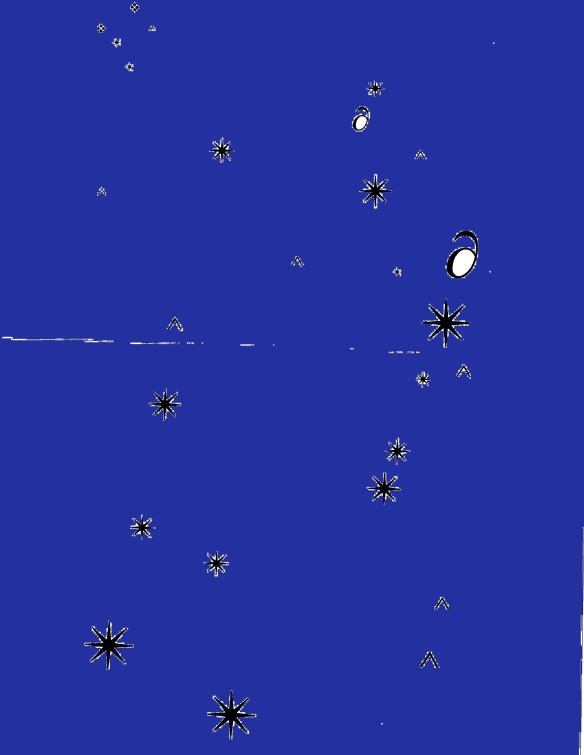
USE A TEXT TO DRAW A FIELD OF STARS.

  • Select a single page of writing from an antiquary textbook on astronomy.
  • Scan this page, using customary software for manipulating photographs.
  • Erase all text from the image, leaving behind only the punctuation marks.
  • Assign to each punctuation mark, a specific style of dot, bullet, or asterisk.

For example:

         ,      =      •
         .      =     ✦
         ;      =     ✹
         :      =     ★
         —   =     ☉

  • Replace each punctuation mark with the specified bullets from your cipher.
  • Vary the point-size of each asterisk, according to the number of letters in the word originally preceding the punctuation (for example: 1 letter = + 0.5 pts).
  • Change the colour of the background to black; change each mark to white.
  • Connect some of the largest dots by drawing lines to make a constellation.
  • Identify the starfield, using the title of the book (and the page number cited).

It took awhile to locate a source, since I have no access today to antiquaries or astronomical treatises other than via the internet.

Although I have used photo editing tools for erasures and blackouts, I am essentially one of the unwashed when it comes to this kind of stuff.  Due to various complications along the way: no white font, a rather rough looking image.

Taurid Meteor Showers

Taurid Meteor Showers_0006


Source http://www.davidchandler.com/2015/11/09/taurids-meteor-showers/

NaPoWriMo 2016 FPR Impromptu 15 Nothing Left

NPM-Bookmark-front-376x1024napo2016button1

FPR Impromptu 15 Love What You Hate   Joel Katelnikoff

In this technological era of direct textual manipulation, we must always acknowledge our own agency as readers. If we hate a text, we may no longer blame the text. Instead, evaluate the text with a particular eye for discovering, within it, that which you can love. Because the thing has not failed you. Rather, you have failed.


Instructions:

Reread the last book that you’ve hated, committing yourself to love it.
Do not expect to experience this love in a linear and continuous manner.
Read quickly, ignoring every element of the text that you might detest.
Flag every element of the text that you are capable of appreciating.
Transcribe all flagged materials.


Not a book I hated, but one I had set aside as a difficult read. A book of essays, some about poetry, others about other forms of writing outside my interests or range of reading. I’ve chosen to select text from Edge, Essays, Reviews, Interviews, by Mary Dalton, (pp. 178-182, 185-186) a Newfoundland poet whose work I greatly admire.  This is from her discussion of the Boatman series of paintings by Newfoundland artist, Gerald Squires.  This exercise has given me a different way to approach the essays when I resume reading it in the next week or so.  It also made me realize that the difficulty is mine, and is one of focus (and that I should not try to read a book with the television on, volume turned down or not).

English: Sea angel (Clione limacina).

Sea angel (Clione limacina) (Wikipedia)


Nothing Left


The figure hovering
chaotic and ill-formed
a smashed skull

within this mass
the tumult of water
an angel crying out in

the otherworld of corkscrew forms
the spiral evolution of universe
flux beneath the sea

a fish rides the great wave
all ribs and bones
nothing left but its sound

and the wild waters
drowning the moon


English: Cartoon drawing about a big fish bein...

a big fish (Wikipedia)

Carol A. Stephen
April 15, 2016

NaPoWriMo 2016 FPR Impromptu 14 14 Lines, Chocolate-Coated

NPM-Bookmark-front-376x1024glopo2016button1

For April 14, the Found Poetry Revew prompt is from Brian Oliu.

It’s a little like Wildminding and a little researching, but from within, as you examine in detail what you want to write about.  Brian says it better though:

Set aside about twenty minutes of your day with the intention of “doing research” for a piece. Do not allow yourself to write about anything that you do not experience firsthand: if you are writing about the feel of water, or the taste of an orange, run your hand underneath the sink or get to the supermarket as soon as possible. Allow yourself to be immersed in your project & only trust “first hand research” instead of cobbling things together from various sources/the Internet–it will be there later for second drafts. If you are writing about a scene in a movie, watch that scene. If you are writing about a trip that you took, try your best to replicate that trip to the best of your abilities. Take notes, but don’t let the notes dictate your experience. After you have concluded your “research” begin writing immediately & without prejudice–don’t stop, don’t worry about linebreaks or punctuation, or word choice: capture whatever fleeting magic you have conjured until the feeling is gone.

To read more about it, and to read about Brian, as well as the poems from other FPR Challenge participants: FPR Impromptu 14 

At first, this sounded rather complex, but as I thought about it, while eating a Cadbury’s Dairy Milk Fruit and Nut Bar, I realized how it was going to work!


14 Lines, Chocolate-Coated


Anticipation. The wrapper rustles, resists
downward pull on paper, corner-torn and open—

the flat brown of chocolate impatience and a second tear
pulls the paper free. One square at a time slides onto tongue.

Instant warmth and saliva melt the surface, teeth feel resistance
as almond remnant cracks free to float a moment in the mouth,
joined next by wrinkle of raisin, the next solitary square.

Each melt of chocolate sets tongue tingling, anticipation still–
for the next and the next and the last, leaving only a vague

memory of how it soothes touch, taste, scent. Only sound and sight
not satisfied by the mere proximity of a bar of chocolate.

Short-lived. In a moment or two the lingering taste fades
to less than memory. And now the struggle to resist attacking
the second beckoning bar.


A chocolate bar and melted chocolate. Chocolat...

A chocolate bar and melted chocolate. Wikipedia

Carol A. Stephen
April 14, 2016