Day 24 Na PoWriMo Write a Lipogram

Day 24 NaPoWriMo says: “Today’s prompt is a bit of a doozy . . . so if you feel like you don’t have it in you, feel free, as always, to take a pass! Today’s challenge is a lipogram/Beautiful Outlaw/Beautiful In-Law. A lipogram is a poem that explicitly refrains from using certain letters. The most classic letter to swear off, at least for English speakers, is “e.” A Beautiful Outlaw is a variation on a lipogram, wherein you refrain from using any of the letters in a certain name. For example, if you chose the name Sarah, then you could not use s, a, r, or h. A Beautiful In-Law is another variant, wherein you only use the letters in a certain name (better pick a long name!)
You might think that any lipogram would end up having to be short, but some people have been successful at virtuoso performances in this vein — check out this excerpt from Christian Bök’s Eunoia, in which he uses no vowels except i. It goes on for nine pages!”

I guess the weather has got me down a bit, still cold although the sun,as it sets, is at its brightest so far today.  Still, the day made me think of storms and cold.

So for the prompt, I chose not to use the letter “i”.  Here’s my effort.

That Sort of a Day

A vacant acorn husk
spawns dream of tree, the oak
drops seed on ground to feed

Acorn hoarded by Acorn Woodpecker

Acorn hoarded by Acorn Woodpecker (Photo credit: Wikipedia)

woodpeckers and jays as they watch for the soak
of groundwater under trees that tease
yellows and reds to dance under

the faffer of breeze, scuddy weather
set free today the greys and blues of sky.

A storm comes on, then gone before
wet drops reach the lawn.
Today the best place to be

a warm bed or curled upon
the sofa where a fat furry cat
warms the soles of cold feet.

Carol A. Stephen
April 24, 2012
Day 23 NaPoWriMo Ekphrastic Prompt

Day 23 NaPoWriMo The prompt said:
” Today, I challenge you to write an ekphrastic poem — that is, a poem that responds to or is otherwise inspired by a work of art. Probably the most famous ekphrastic poem in English is Keats’ Ode on a Grecian Urn, but there is no lack of modern ekphrastic work. Take Auden’s Musee de Beaux Arts or Robert Lowell’s For the Union Dead. So go forth and find a painting, sculpture, photograph, or even a piece of music, and use it to inform your poem for today. Art creates art — it’s so efficient!”

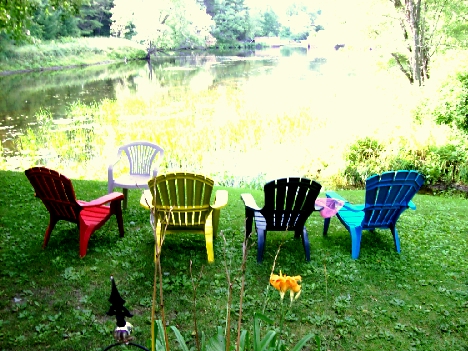
I used a favourite photo I took a couple of years ago at a writing retreat at Bridgewater, a place for artists and writers about two hours from home.

Where Have All the Poets Gone?

A Contemplation of Poets

On hot summer days even the sun
floats on the river for relief
hard bright light fading trees
to a blur that only remembers soft green.

Shade offers daylilies reprieve
from heat, yet their petals
curl and fade, prepare to fall.
Only the bright chairs

appear untouched by heat and fade
their colours brilliant even
in the shade. They wait. Poets
not seen but somewhere
near and always contemplating.

Carol A. Stephen
April 23, 2012

Day 22 NaPoWriMo Fruit or the Vegetable Lamb or…

The prompt for today said “I’d like you to write a poem about a plant. Flowers, of course, have been the subject of poems since time immemorial, and continue to be a source of much inspiration. But perhaps you could write about a tree, or a shrub, or grass. Maybe even a fictional or mythological plant. I could really see some good poems about the Vegetable Lamb of Tartary! (In fact, a few poems were written about it, back between 1550 and 1800. I say it’s time for a renaissance!)” 

The Vegetable Lamb of Tartary

The Vegetable Lamb of Tartary (Wikipedia)

Carol A. Stephen

So I read about that and it was interesting, another of those stories where everyone has a version and they are not necessarily the same, but not different either. So here’s my poem:
Of Mythical Tales of Watersheep and Barnacle Geese

Were watersheep born on the stem of a plant,
or Barnacle geese born of wood drifted slant,
or maybe both spawned from some strange fleshy fruit?
Perhaps they were mythical creatures to boot,
the stories embellished for use on fast day,
so men could still savour their meals on Friday.

Barnacle Geese. Facsimile of an Engraving on W...

Barnacle Geese. Facsimile of an Engraving on Wood, from the "Cosmographie Universelle" of Munster, folio, Basle, 1552. Project Gutenberg text 10940 (Photo credit: Wikipedia)

These men of the cloth and of pious belief
could eat meat those days in such a relief,
that these were the fruits of the water, the sea,
and so could be eaten most sensitively

on fish days and fast days and days in between,
they’d not have to worry the meat might be seen.
If meat is a fruit, it could be tomato,
or if it’s veggie, it could be potato,
and then there’s no sin that must be repented
no penance to do, and nothing resented.

It all sounds quite silly, I think you’ll agree,
just another old wives’ tale if you ask me.

Carol A. Stephen
April 22, 2012

Here, also, real Barnacle Geese, looking perfectly

normal.

Two Barnacle Goose (Branta leucopsis)

Two Barnacle Goose (Branta leucopsis) (Photo credit: Wikipedia)

Day 21 Write a Hay (na) ku

Ok, so I will never be a Hay (na) ku poet.  My feeble attempts. Since they were bad, I figured quantity over quality might work.  lol


My
cat complains.

Photo of a siamese cat

(Wikipedia)

Being a cat.

He
pokes me
with his paw.

My
eye blinks
with the pain.

***
Cattle

Grass

Grass (Photo credit: Mathew Knott)

graze widely.
Grass shortage imminent.

***

Reverse hay(na)ku

Left-brain-justified
my own
creation.

***
Computer monitor black
Terminal error
unplugged.

Windows 3.1 black screen of death caused by an...

black screen of death error in DOS-based app (Wikipedia)